Chapter 9
### Part 9
Three years later, I saw Oriana in a hospital waiting room.
Not as a patient. Not as family.
As a visitor sitting beneath a television mounted too high on the wall, chewing the side of her thumbnail while rain streaked the windows behind her.
I was halfway through my clinical rotation in internal medicine. My white coat had a coffee stain near the pocket, my hair was escaping its clip, and my feet hurt so badly I had stopped feeling them two hours earlier. The hospital smelled like antiseptic, cafeteria soup, and the metallic edge of winter coats drying on plastic chairs.
I did not recognize her at first.
Then she looked up.
Her face changed as if someone had opened a door and let cold air in.
“Marlowe.”
I stopped.
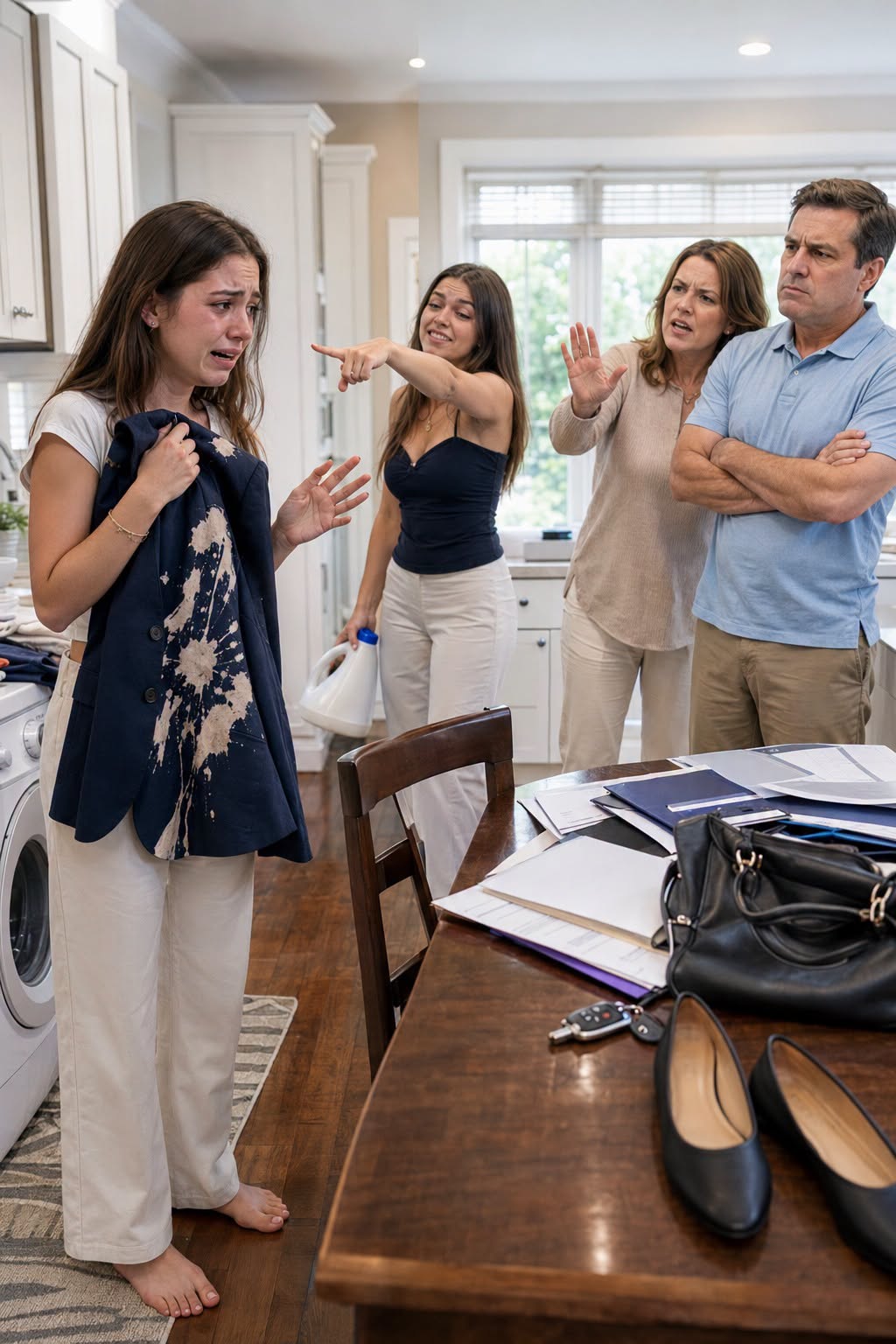
For one strange second, the hallway folded in on itself. I was back in my childhood kitchen holding a ruined blazer. She was at the table with cereal. My mother was saying, “You have no proof.”
Then the moment passed.
“Oriana,” I said.
She stood too quickly. “I didn’t know you were here.”
“I work here.”
Her eyes moved to my badge. My white coat. The stethoscope around my neck.
“Right,” she said. “Of course you do.”
There was no apology in her voice. Only discomfort wearing a nicer coat.
I could have walked away. I should have. But a nurse at the desk called my attending’s name, and I had thirty seconds before I needed to move.
“Who are you here for?” I asked.
“Dad.”
The word landed without warning.
I kept my face still. “What happened?”
“Chest pain. They’re running tests.”
For years, I had imagined what I would feel if one of them needed me. Satisfaction, maybe. Fear. Anger. Some dramatic swell of old love rising despite everything.
Instead, I felt a quiet human concern, distant but real, like seeing smoke from a house you no longer lived in.
“I hope he’s all right,” I said.
Oriana’s mouth trembled, and for a second she looked young. Younger than twenty-five. Younger than the sister who had signed witness forms and poured bleach like a dare.
“Mom wants to see you.”
“No.”
The answer came easily.
That surprised both of us.
“She’s different now,” Oriana said.
“I’m not.”
She flinched.
I did not say it cruelly. I said it because it was true.
My pager buzzed against my hip.
Oriana looked down at it, then back at me. “Do you ever think maybe we were all just young and stupid?”
“You were young,” I said. “Mom and Dad weren’t. And stupid doesn’t explain forging signatures.”
Her face went red.
People in waiting rooms pretend not to listen. They always listen.
Oriana lowered her voice. “I lost everything because of that.”
“No,” I said. “You lost things that were never yours.”
The words settled between us.
For once, she had no quick answer.
Down the hall, my attending called, “Vesper, you coming?”
“Yes, doctor.”
Oriana stared at me like the title hurt her ears.
Before I turned away, she said, “The blazer. Did you keep it?”
I looked back.
“Yes.”
“Why?”
I thought of all the answers I could give. Evidence. Memory. Armor. Proof. A warning.
But the simplest one was enough.
“Because it tells the truth.”
Her eyes filled, but I did not stay to find out whether the tears were for me, for herself, or for the story she could no longer control.
I walked down the hallway toward my patients.
By then, the settlement money had carried me through rent, exams, books, and the thousand hidden costs of becoming a doctor. I had started a small scholarship fund in my grandmother’s name for pre-med students from rural towns. Nothing huge. Nothing flashy. Just enough to pay application fees, interview travel, a used suit, a hotel room, the small things that decide who gets to look prepared.
The first recipient sent me a photo of herself before her interview.
She wore a navy blazer with one missing button.
I printed the photo and tucked it into the pocket of my ruined one.
The blazer still hangs in my closet in New Haven. I don’t wear it. I don’t need to. It has done more work than any perfect jacket ever could.
My parents are alive. Oriana is alive. We are not a family in the way people mean when they soften the word. My mother sends an email every few months. I do not answer. My father sent a birthday card once with no return address and a check for fifty dollars inside. I donated it to the clinic where I used to volunteer.
I did not forgive them.
I did something better for myself.
I stopped waiting for them to become people who would have protected me.
There are betrayals that do not deserve a reunion scene. There are apologies that arrive only after the bank account empties, after the lawyer calls, after the favorite child’s car is returned, after the story can no longer be bent into something flattering.
Late love, I have learned, is not always love.
Sometimes it is just fear wearing perfume.
On the day I matched into internal medicine, I stood outside the hospital with my friends while confetti stuck to the wet sidewalk. Nessa screamed louder than anyone. Armand cried openly. Talia hugged me so hard my ribs ached.
Dr. Thorne found me afterward.
His hair was whiter by then. His smile was the same.
“Do you still have it?” he asked.
I knew what he meant.
“Yes.”
“Good,” he said. “Some students keep diplomas on the wall. You should keep that.”
“I do.”
That evening, I went back to my apartment, opened the closet, and touched the pale stain on the lapel.
Once, someone had poured bleach on my only armor because she thought damage would make me disappear.
Instead, it made me visible.
Once, my parents stole the money my grandmother left for my future because they assumed I would keep working, keep sacrificing, keep being the daughter who survived without asking who had made survival so necessary.
Instead, I took it back.
Not with screaming.
Not with begging.
Not by becoming cruel.
I took it back with paper trails, signatures, bank records, silence, and the same ruined blazer they thought would shame me.
That was the part they never understood.
They had looked at the stains and seen failure.
Yale saw endurance.
My lawyer saw evidence.
I saw a map.
And every time I pass a young student in a waiting room wearing shoes too cheap for the occasion, holding a folder too tightly, trying not to look scared, I want to tell them what nobody told me when I needed it most.
Go anyway.
Wear what you have left.
Walk into the room.
Let them see what tried to stop you.
May you like



Then take back every single thing that was yours.
THE END!







