Chapter 4
### Part 4
Six weeks later, the acceptance letter arrived during a freezing rainstorm.
It was a thin envelope, which made my stomach drop before I opened it. Everyone tells you thick envelopes are good and thin envelopes are bad, even though most things happen online now. I stood at the mailbox in my mother’s old raincoat, water dripping off the hood onto my wrists, staring at the Yale crest in the corner.
My hands did not shake when I tore it open.
They went numb.
Dear Ms. Vesper,
Congratulations.
I read the first line four times before the rest of the words became real. Accepted. Full merit scholarship. Incoming class. Ninety-one students selected from thousands of applicants. A separate note about a rural health leadership track. A handwritten sentence at the bottom from Dr. Thorne.
Bring the jacket to New Haven. It belongs here too.
For one wild second, I laughed in the rain.
Then I remembered where I was.
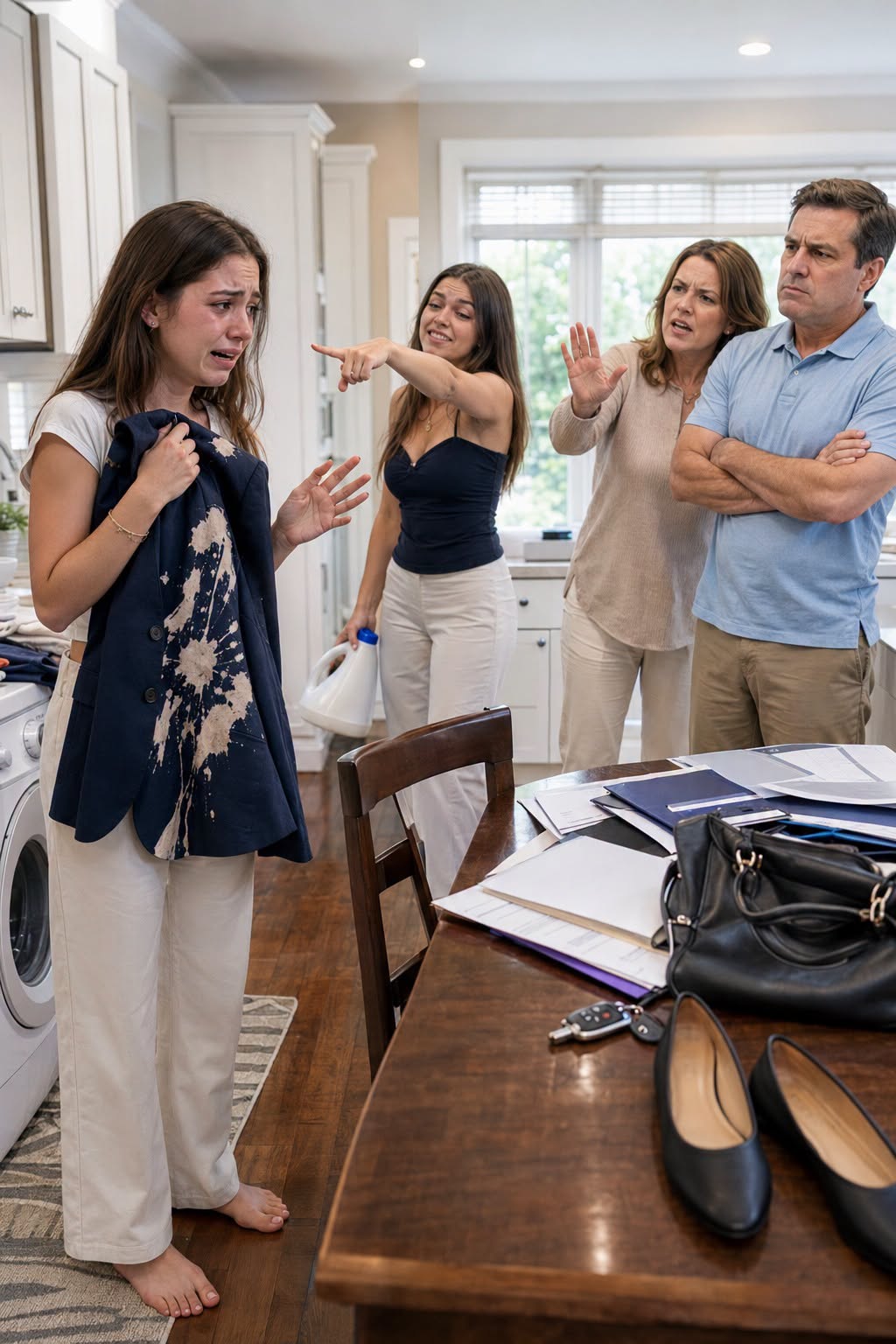
The house sat behind me with yellow kitchen light in the windows. The same house where my blazer had been ruined. The same house where my mother had told me not to make a scene. The same house where nobody had said sorry.
I folded the letter carefully, went inside, and placed it on the kitchen table.
My mother was slicing onions for soup. The smell was sharp and sweet, filling the room. My father was reading local sports scores on his tablet. Oriana sat by the window painting her nails a deep wine red, the bottle open beside her.
“I got in,” I said.
My mother’s knife stopped.
My father looked up.
Oriana did not.
I slid the letter across the table.
My mother read it first. Her lips parted. For a moment, something like pride crossed her face, but it was late and hungry, reaching for a seat it had never earned.
“Oh, Marlowe,” she said. “I always knew you would do something special.”
I held up one hand.
“Don’t.”
The word was not loud, but it cut cleanly through the room.
Her face changed. “Excuse me?”
“Don’t rewrite this.”
My father lowered the tablet. “This is not the time.”
“It never is.”
Oriana blew on her nails. “Congratulations. Try not to act superior about it.”
I turned to her. “Did you ruin my blazer?”
My mother made a tired sound. “Marlowe.”
“No,” I said. “I’m asking her.”
Oriana looked up at last. Her eyes were flat. “You got in, didn’t you? Why are you still whining about a jacket?”
There it was.
Not a confession.
Not exactly.
But close enough to leave fingerprints.
My father stood. “Enough. Your sister congratulated you.”
“No, she didn’t.”
“She doesn’t express things the way you do.”
“She destroyed the only professional jacket I owned.”
My mother gripped the edge of the sink. “You have no proof.”
Those four words stayed with me.
Not, “She didn’t do it.”
Not, “That would be terrible.”
You have no proof.
I looked at my mother, really looked at her, and saw something I had missed my entire life. She was not blind to Oriana’s cruelty. She was invested in denying it. There is a difference.
“I’m moving to New Haven in July,” I said. “Until then, I’ll stay out of everyone’s way.”
My father’s jaw tightened. “Medical school is expensive even with tuition covered.”
“I’ll manage.”
“Rent. Food. Insurance. Books. You think scholarships cover life?”
“I said I’ll manage.”
My mother turned too quickly back to the onions. The knife hit the cutting board in fast, uneven strokes.
Oriana smiled at her nails.
For the next two months, the house became polite in a way that felt more dangerous than yelling. My mother offered me coffee. My father asked about forms. Oriana borrowed my car once without asking and returned it with the gas light on. I kept the Yale letter in a folder under my mattress because I no longer trusted my own room.
Then the financial aid office emailed me.
The subject line was ordinary.
Verification Request: Outside Educational Assets
I opened it between lunch and dinner shifts at the diner. The restaurant smelled like grilled onions, coffee, and lemon cleaner. Plates clattered behind me. My manager, Del, was arguing with a supplier near the back door.
The email said Yale had received a federal verification flag connected to a disclosed educational trust under my Social Security number.
I read that sentence three times.
Educational trust?
There was no trust.
I had filled out every form myself. I had reported my savings account, my income, my tips, my tiny retirement account from the diner that had maybe $312 in it. I had nothing else.
Attached was a request for documentation related to the Vesper-Solenne Education Fund, established fourteen years earlier.
Solenne was my grandmother’s maiden name.
My grandmother, Junia Solenne, had died when I was eleven.
I remembered her hands smelling like lavender soap. I remembered her teaching me how to sew a button. I remembered her saying, “One day, you’ll leave this house, and you’ll need something of your own.”
I stood in the diner hallway with grease on my shoes and the phone glowing in my hand.
Something of your own.
Behind me, Del shouted, “Marlowe, table four needs coffee.”
I looked at the attachment again.
May you like



The trust had been established for my education.
The current balance was listed as zero.







