Chapter 6
### Part 6
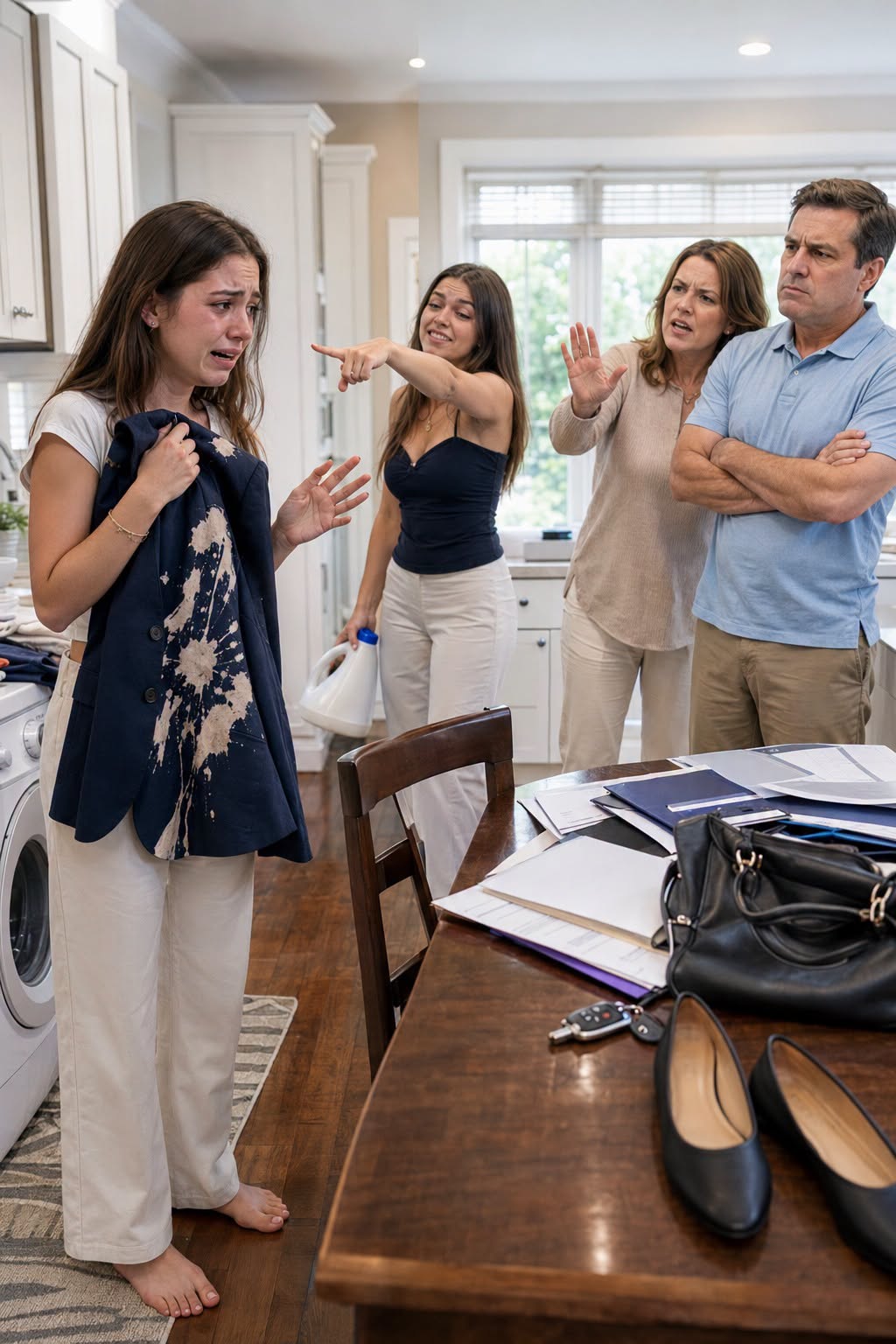
I moved to New Haven in July with three suitcases, a box of books, and the ruined blazer zipped inside a garment bag.
My parents did not help.
My mother stood on the porch with her arms folded, pretending the humidity bothered her eyes. My father shook my hand again, formal and stiff, like I was a coworker leaving for another district. Oriana stayed inside. I saw her silhouette in the upstairs window, phone raised, probably recording the moment so she could laugh about it later.
“Call when you arrive,” my mother said.
I put the last box in my trunk. “No.”
Her face tightened. “Marlowe, don’t be cruel.”
I almost smiled at that.
Cruel.
People who take your inheritance and bleach your blazer still expect softness in your voice.
“I’ll communicate through email about anything important,” I said.
My father stepped forward. “What does that mean?”
“It means I’m done having conversations nobody remembers accurately.”
Something moved across his face.
Fear.
Small, quick, gone.
But I saw it.
New Haven in summer smelled like hot pavement, coffee shops, cut grass, and rain trapped in old stone. My apartment was a third-floor walk-up two blocks from campus, with radiators that clanked even when they were off and a kitchen so small the fridge door hit the opposite counter. I loved it immediately.
The first night, I hung the blazer in the closet.
I stood there looking at it for a long time.
The bleach stains were no longer bright. They had settled into the fabric like scars. I thought of Dr. Thorne’s words. Keep that jacket.
I did.
Medical school began like being pushed into deep water.
Anatomy lab. Lectures. Small groups. Acronyms. Coffee. More coffee. The strange intimacy of learning the human body piece by piece while your own body survived on granola bars and panic.
I made friends slowly.
There was Nessa Vale, who had been a paramedic in Detroit and could read people faster than anyone I had met. There was Armand Pike, who wore colorful socks to exams because he said fear needed opposition. There was Talia Greer, who had a laugh like a dropped tray and a memory sharp enough to frighten professors.
They knew about the blazer before they knew about my family.
Not because I told them.
Because Dr. Thorne did.
At orientation, he gave a speech about resilience. Halfway through, he said, “One of you arrived at an interview wearing visible evidence that someone had tried to make you feel unworthy. That person answered every question with more honesty than many applicants manage in perfect suits.”
Everyone turned their heads.
I wanted to disappear under my chair.
Then Nessa leaned toward me and whispered, “Please tell me that was you.”
I stared straight ahead. “Unfortunately.”
She grinned. “Iconic.”
The lawsuit moved quietly beneath my new life like an underground river.
Ione filed a formal demand for accounting. My parents ignored the first letter. They answered the second through a local attorney who claimed all distributions had been made “for Marlowe’s benefit” with my “knowledge and consent.”
Ione sent back copies of my work schedules from the diner, bank records showing I had paid my own tuition gaps, MCAT receipts, application fees, rent transfers during college, and emails where my mother had refused to help with textbooks.
Then she asked for original signed documents.
That was when my mother called.
I was in the library basement at 9:42 p.m., surrounded by flashcards and the smell of vending machine pretzels, when my phone lit up.
Mom.
I watched it ring.
Then I let it go to voicemail.
A minute later, a message appeared.
“Marlowe, this is getting out of hand. Your father and I did what we thought was best. That money was family money. You know how hard things were. Call me before you destroy us over a misunderstanding.”
Family money.
My grandmother’s will said otherwise.
The next morning, I forwarded the voicemail to Ione.
She replied with one sentence.
Do not respond.
So I didn’t.
Silence, I discovered, was not weakness. Sometimes silence was a locked door.
In September, I received an email from an address I did not recognize. The subject line read: You think you’re better than us.
Oriana.
The body of the email was only three lines.
You always wanted to make Mom and Dad look bad.
That money kept this family afloat.
And by the way, the jacket looked better after I fixed it.
I sat at my desk, staring.
There it was.
A confession wrapped in cruelty because she had never been able to resist signing her work.
I forwarded that too.
Three days later, Ione called.
Her voice was calm, but I heard the steel under it.
“Marlowe,” she said, “your sister just gave us the thread that ties the pattern together.”
I looked across my tiny kitchen at the blazer hanging from the closet door.
For the first time, I understood.
May you like



The jacket was not just a symbol.
It was evidence that they had been trying to stop me long before I knew what they had stolen.







