Chapter 1
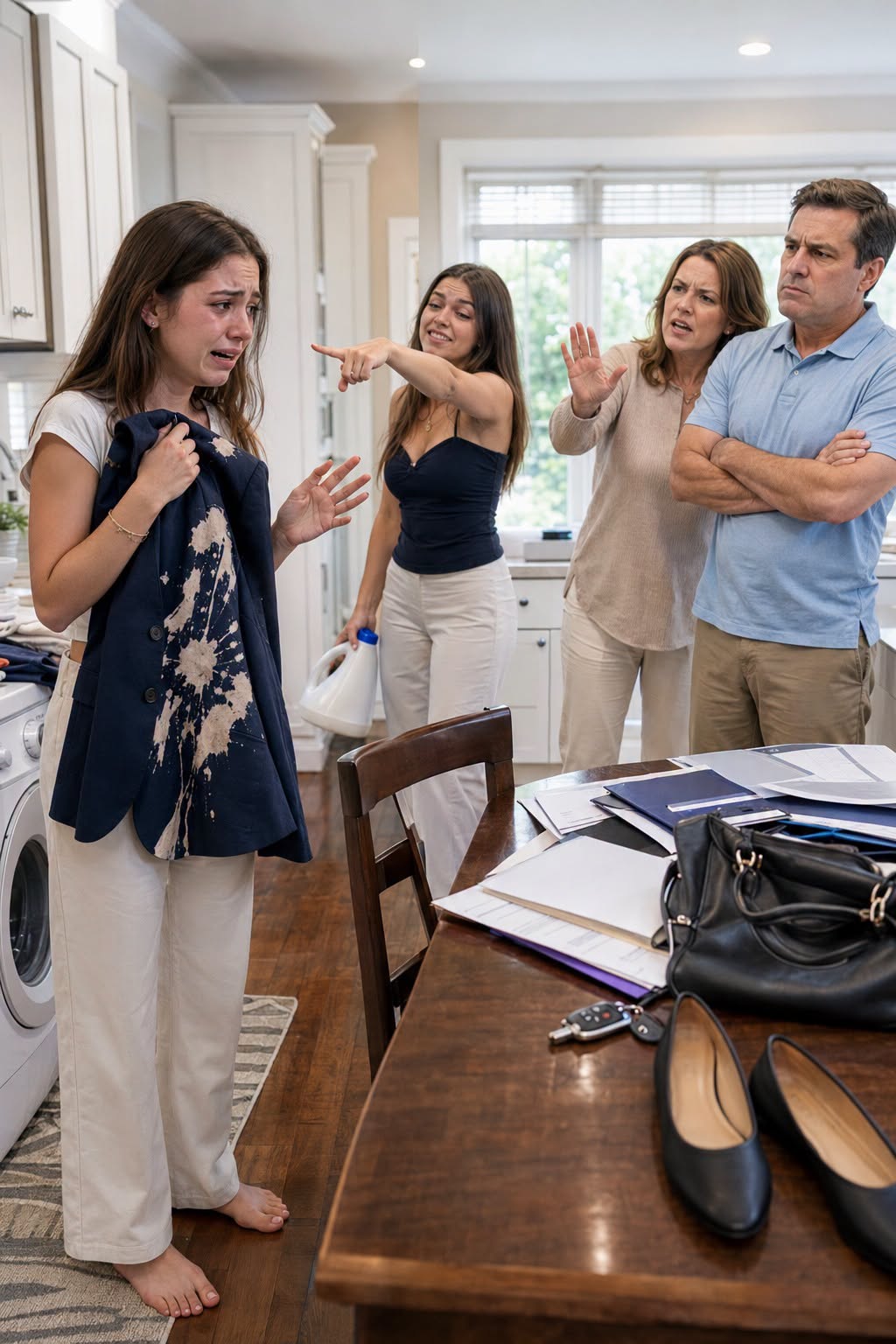
The Night Before My Medical School Interview, My Sister Poured Bleach On My Only Blazer. My Parents Told Me To “Stop Making A Scene.” I Wore It Anyway. The Dean Looked At My Bleached Jacket, Then At My Last Name. His Expression Changed. “Wait… You’re Her?”
### Part 1
My name is Marlowe Vesper, and the morning my family tried to ruin my future began with the smell of bleach.
I woke up at 5:03 a.m., before my alarm, before the birds, before the furnace clicked alive in the hallway of my parents’ narrow house in western Connecticut. The room was still dark except for the weak blue glow of my phone on the nightstand. I had slept maybe three hours, maybe less. Every time I closed my eyes, I saw the same image: a long conference table at Yale School of Medicine, four interviewers, my application file, my hands folded so tightly my knuckles turned white.
The interview was at 6:00 p.m.
Fourteen hours away.
Three years of my life had been pointed toward that day like an arrow. I had taken the MCAT twice because the first score was good but not enough. I had worked double shifts at a diner off Route 8, smelling like coffee and fryer oil until midnight, then gone home to review biochemistry flashcards under a lamp that flickered when it rained. I had volunteered at a free clinic where the waiting room always smelled like hand sanitizer, wet coats, and old fear. I had written a research paper about rural health access using data I collected myself because nobody in my town cared enough to count the people falling through the cracks.
I did not come from people who said things like, “You can do anything.”
In my house, ambition was treated like a mess someone else had to clean up.
My father, Callan, was a high school athletic director who believed a person’s worth could be measured by how little trouble they caused him. My mother, Sable, worked part-time at a dentist’s office and full-time defending everyone except me. And my younger sister, Oriana, had grown into the kind of person who could smile while stepping on your foot under the table.
She was twenty-two, pretty in a careless way, with glossy hair and a voice that turned sweet whenever anyone important entered the room. She had never forgiven me for being good at school. That was the plainest way to say it. Every scholarship letter, every award, every professor who remembered my name made something harden behind her eyes.
The one thing I had for the interview was my blazer.
Charcoal gray. Wool blend. Secondhand, but clean, tailored, and sharp enough to make me feel like I belonged somewhere with marble floors and heavy wooden doors. I had bought it from a consignment shop two towns over after saving tip money in a mason jar for seven weeks. The clerk had said, “This is a lucky find,” and I had believed her.
I hung it on the back of my closet door for three days before the interview. I brushed it. Steamed it. Tried it on with my white blouse and black trousers. I stood in front of the mirror and practiced saying, “My long-term goal is to practice internal medicine in underserved communities,” without sounding desperate.
Advertisements
At 7:28 a.m., I went downstairs for toast.
Oriana was at the kitchen table scrolling her phone, one bare foot tucked under her thigh, cereal going soggy in a chipped blue bowl. My mother stood by the counter pouring coffee, her robe tied crookedly. My father’s shoes were by the back door, still damp from taking out the trash.
“Big day,” my mother said, without turning around.
It was the kind of tone that meant she wanted credit for noticing.
“Yeah,” I said.
Oriana snorted softly into her cereal.
I ignored her. I had learned that ignoring her was safer than answering. I ate half a slice of toast, drank water, and went back upstairs to start getting ready.
The smell hit me before I reached my room.
Sharp. Chemical. Clean in the wrong way.
My bedroom door was open.
The blazer was still hanging where I had left it, but it looked different even from the hallway. The left shoulder had gone pale. At first, my mind refused to understand it. I walked closer slowly, like a person approaching a sleeping animal. Then I lifted the hanger into the morning light.
Bleach had eaten across the front panel in cloudy, uneven patches. It had dripped down the lapel and bled into the seam near the buttons. The gray wool was no longer gray. It looked wounded. Marbled. Ruined.
Not spilled.
Poured.
My fingers went cold around the hanger.
I stood there while the house made ordinary sounds around me. Pipes humming. A truck passing outside. Oriana’s laugh downstairs, light and careless, like she had heard something funny.
For one breath, I was twelve years old again, staring at a science fair board she had “accidentally” knocked into the basement sink. I was seventeen, finding my college recommendation letter opened and stained with coffee. I was twenty-one, watching my mother shrug after Oriana told relatives I had only gotten my scholarship because “schools love charity cases.”
But this time, I had no spare.
No money.
No time.
I carried the blazer downstairs with both hands.
Oriana looked up first. Her eyes flicked to the stains, then away so fast anyone else might have missed it.
I did not.
My mother turned from the counter. “What is that smell?”
I held up the blazer. “Did you do this?”
Oriana blinked at me. “Do what?”
“This was clean last night.”
“Maybe you did it.”
“I didn’t pour bleach on my own interview jacket.”
My mother set her mug down too hard. Coffee jumped over the rim. “Marlowe, lower your voice.”
My father appeared in the doorway, tying his watch. “What’s going on?”
“Someone destroyed my blazer,” I said.
Oriana leaned back in her chair. “It’s just a jacket.”
The room went very still.
My mother looked at the blazer, then at my face, and chose her side without moving an inch.
“Don’t start something before your big day,” she said.
My father sighed like I had inconvenienced him. “Your mother’s right. Handle it like an adult.”
I stared at all three of them, and something quiet inside me cracked cleanly down the middle.
Because nobody asked how it happened.
Nobody asked who had been in my room.
Nobody said, “I’m sorry.”
May you like



Oriana lifted her spoon and smiled into her cereal.
And in that exact second, I understood that the blazer was not the first thing they had taken from me. It was just the first thing they had ruined where I could see the stains.







