Chapter 6
### Part 6
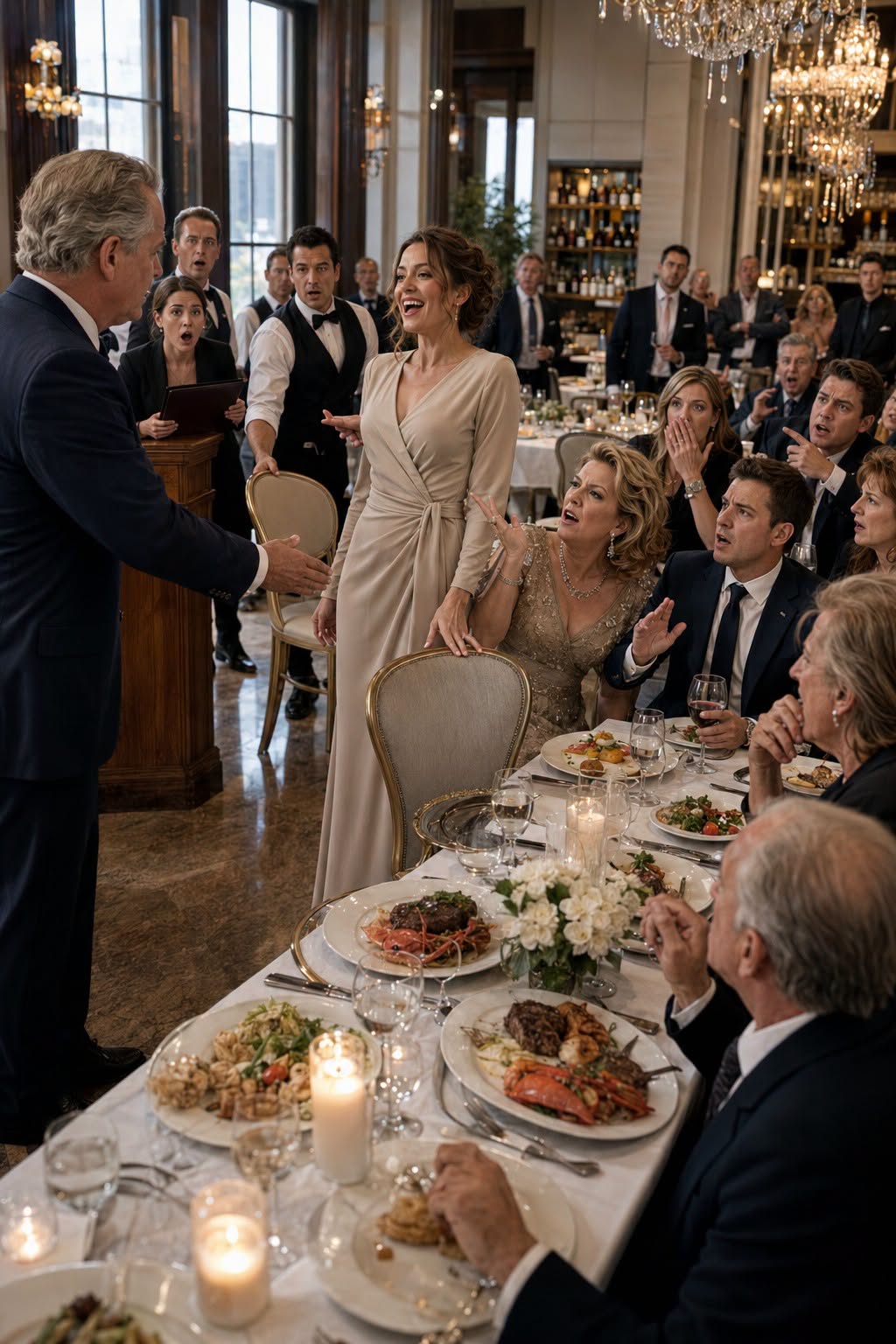
After Arlo called me “Chef,” the dinner stopped being a dinner and became a room full of people discovering they had misread the seating chart of my life.
Cordelia stayed standing, one hand on the table, her diamond bracelet glittering under the chandelier. Her face had arranged itself into disbelief because disbelief was safer than fear.
“This is theater,” she said. “A childish little scene.”
I looked at the empty place where my chair should have been.
“I agree,” I said. “It was childish.”
A few people at nearby tables turned away too late, pretending not to listen. The waiter stood near the wine cabinet, frozen with a bottle in his hand. The air smelled like seared butter, rosemary, and expensive panic.
Callan rose halfway.
“Everyone needs to calm down.”
I turned to him. “Sit down, Callan.”
His mouth opened.
No sound came out.
Maybe it was the way I said it. Maybe it was the folder. Maybe it was six years of obedience leaving my body all at once. Whatever he saw in my face made him lower himself back into the chair.
Cordelia noticed. Her eyes sharpened with offense.
“You do not speak to my son that way.”
“I’ve spoken to your son gently for years,” I said. “Look where it got me.”
Sable began crying softly, though nobody had touched her. Sable cried whenever the truth entered a room without asking her permission.
Bram leaned toward Callan and whispered something.
Arlo heard it.
So did I.
“Can she actually do this?”
I almost smiled.
Maren Vale remained beside my table, uncomfortable but attentive. She had the composure of someone who knew when a business relationship was being clarified in real time. I felt bad she had been pulled into the Voss family performance, but another part of me was grateful. A witness with power changes the temperature of a lie.
I opened the operating agreement to the membership section.
“Callan’s ten percent stake remains intact pending appraisal and any divorce-related settlement discussions,” I said. “I’m not stealing anything from him. I’m correcting a false narrative.”
Cordelia laughed harshly. “A false narrative? My son has been on every stage. Every interview. Every magazine profile.”
“Yes,” I said. “Because I put him there.”
Hollis finally spoke. His voice was quiet, stunned. “Callan, is that true?”
Callan looked at his father, then at me, then at the folder.
“It’s more complicated,” he said.
That was when I knew he had no defense.
People with the truth say yes or no. People with exposure say it’s complicated.
Cordelia pointed at the folder. “Those documents could say anything.”
“They do,” I said. “That’s the purpose of documents.”
Arlo coughed into his fist. It was not subtle.
A flash of memory hit me so hard I almost lost the room.
Callan and I at our kitchen table years earlier, eating takeout noodles from paper cartons, him signing those very pages while joking that he trusted me more than he trusted himself.
“Good,” I had said.
He had smiled. “You should.”
And I had.
God help me, I had.
I pulled out another page.
“This is the capital contribution ledger. Initial capital came from my consulting income, my personal savings, and the first acquisition loan secured against assets I owned before the marriage.”
Cordelia’s cheeks flushed. “You always were vulgar about money.”
“No,” I said. “You were always vague about it because the truth embarrassed you.”
Hollis closed his eyes.
Sable whispered, “Mom, stop.”
But Cordelia could not stop. People like her would rather set the house on fire than admit they had been warming themselves by someone else’s furnace.
She pointed at Maren.
“And you,” she snapped. “Surely Dominion House understands that Callan is the public identity of this brand.”
Maren’s polite expression cooled.
“Dominion House understands founder-led operations,” she said. “We also understand governance. Our revised letter of intent will go to the managing member.”
Callan flinched.
Cordelia saw it.
There are moments in public humiliation when the victim and the villain switch places without anyone moving.
This was that moment.
The laughter from earlier had curdled. The Voss relatives no longer looked amused. They looked worried. Not for me. Not even for Callan, exactly. They were worried because money had entered the room wearing my name.
Bram stood abruptly.
“I don’t think this is appropriate,” he said.
I looked at him. “You’re right. Opening my staffing model and presenting it as your future operational plan was inappropriate.”
His face drained.
Sable turned on him. “You said Callan approved that.”
“He did,” I said.
Callan slammed his hand on the table. “Enough.”
The sound cracked through the dining room.
For the first time all night, anger entered his voice plainly.
“You think you can just walk in here and destroy me?” he said.
I looked at the empty space at the table.
“No,” I said. “I think I walked in here and found out how long you had been trying to destroy me.”
His eyes glistened. Maybe with tears. Maybe with fury.
“Jules, I was trying to protect the company.”
“From whom?”
He did not answer.
I stood.
The navy folder closed with a soft snap.
“On Monday, Gideon Vale will file notice removing you as managing partner. Your access to accounts, internal systems, corporate cards, and employment authority will be suspended according to the sixty-day provision you signed.”
Sable made a small sound.
Bram whispered, “Sixty days?”
I continued.
“Dominion House will receive updated governance documentation. Bram will not be joining operations. And Callan, I’m filing for divorce.”
The last word seemed to empty the room of oxygen.
Callan’s face changed completely.
Not because he loved me enough to fear losing me.
Because he had not believed I would leave.
That realization hurt more than I wanted it to.
Cordelia gripped the back of her chair. “You ungrateful little—”
Arlo stepped forward.
“Mrs. Voss,” he said calmly, “this is my dining room tonight. I’d choose the next word carefully.”
Cordelia stared at him, stunned that anyone wearing a chef coat would dare interrupt her.
I looked at Arlo.
He gave me the smallest nod.
I picked up my clutch.
Then I walked past the table.
Callan reached for my hand.
“Jules,” he said, and for the first time, his voice cracked. “Wait.”
I stopped.
Every part of me remembered loving him. His sleepy smile in the early mornings. His hand on my back in crowded rooms before I understood he was steering me out of the frame. The way he once said, “We’re going to build something nobody can take from us.”
We had.
He just forgot who built it.
I pulled my hand free.
“No,” I said. “I waited six years.”
Then I walked out.
The jasmine hit me first.
Then the cool night air.
Then the truth.
May you like



I was alone in the parking lot.
And I had never felt less abandoned.







