Chapter 2
### Part 2
I did not sit down right away.
I let the silence stretch, because silence in the right hands can cut cleaner than anger.
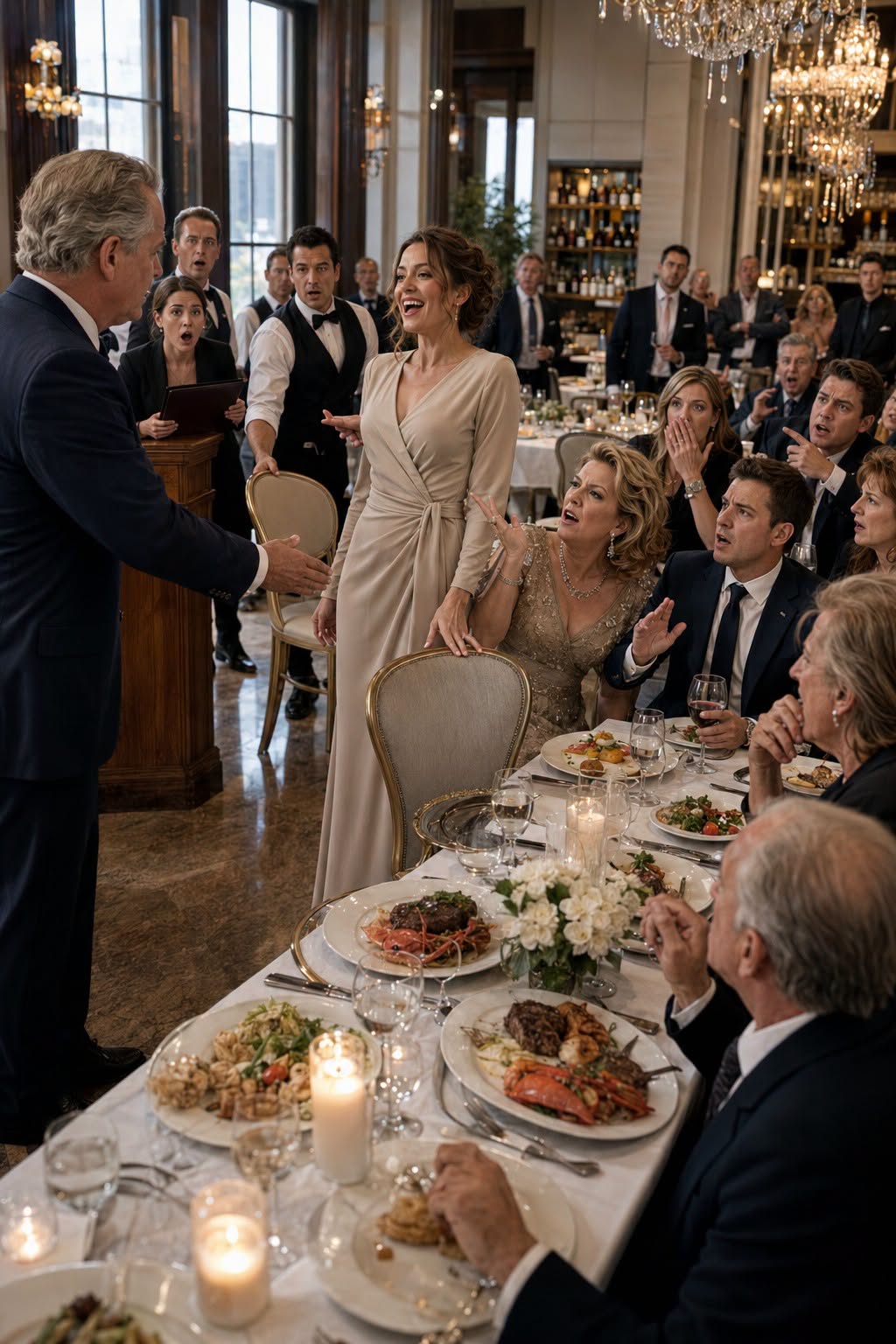
The chef’s table at The Aurelia sat beside the open kitchen, separated from the main dining room by a half wall of dark walnut and glass. It was the best seat in the house, the seat where critics, investors, celebrities, and people who used phrases like “culinary experience” sat while pretending they understood why one sauce took three days to make.
Arlo pulled the chair back for me like it was a throne.
Cordelia stared at him as if he had carried out a tray of live snakes.
“I’m sorry,” she said, recovering enough to lace her voice with ice. “Do you know my daughter-in-law?”
Arlo did not even glance at her.
“I know my boss,” he said.
The word landed on the table like a dropped knife.
Sable’s wineglass froze halfway to her mouth. Bram’s smirk collapsed. Hollis looked at Callan with a confused frown, and Callan looked like a man watching a locked door open from the wrong side.
I sat.
The chair legs made a soft scrape against the floor. It was not loud, but every person at that table heard it.
Arlo leaned slightly toward me. “Still no cilantro on scallops?”
“Still no reason to ruin scallops,” I said.
His mouth twitched.
That tiny exchange did more damage than any speech could have. Familiarity. History. Respect. Things Cordelia had spent years insisting I did not possess.
A server placed water in front of me. Another brought a folded napkin. From the kitchen, the staff kept moving, but their glances flicked toward me with that quiet loyalty people only give when they have seen you bleed beside them during service.
Cordelia lifted her chin. “Callan, perhaps you’d like to explain why the chef of this restaurant is calling your wife his boss.”
Callan wiped his mouth with his napkin though he had not eaten anything.
“It’s just industry talk,” he said.
I looked at him. “Is it?”
His eyes flashed a warning.
That was familiar too.
For years, Callan had warnings disguised as tenderness.
“Not here, Jules.”
“You’re overreacting, Jules.”
“Mom doesn’t understand how her words sound.”
“Let me handle the room.”
At first, I mistook it for protection. Later, I understood that he was not protecting me from rooms. He was protecting rooms from me.
A woman in a charcoal suit rose from a table near the window and approached slowly, her expression sharpening with recognition. She carried herself like someone who was never unsure whether she belonged anywhere. I knew her before she reached me.
Maren Vale, senior vice president of development for Dominion House Hotels.
We had sat across from each other in Chicago two months earlier, surrounded by coffee cups, city noise, and a projection screen showing numbers that had taken me eleven months to build.
“Juliana Kestrel,” she said, extending her hand.
I stood to shake it.
“Maren. It’s good to see you.”
She glanced toward Callan’s table, then back at me. “I didn’t realize you were dining with the Voss family tonight.”
“Neither did they, apparently.”
Her eyes moved to the empty space at the table. She understood immediately. Women like Maren never needed the whole story when the room had already confessed.
Cordelia stood.
“This is a private family dinner,” she said.
Maren gave her a polite smile. “Then I won’t interrupt long.”
She turned back to me. “I wanted to say congratulations again. The board was impressed. The pro forma was unusually strong, but the operating model was what sold them. You built something rare.”
The Voss table went still.
Hollis cleared his throat. “Operating model?”
Bram shifted in his chair.
Sable whispered, “Callan?”
Callan’s face had lost color around the mouth.
Maren looked between them, finally realizing she had stepped into the middle of something sharper than a business dinner.
“I’m sorry,” she said carefully. “I assumed everyone here knew Juliana runs Kestrel Hearth Hospitality.”
Cordelia laughed once. It sounded brittle. “That’s absurd.”
I picked up my water glass and took a sip. My hand did not shake.
Cordelia’s eyes narrowed. “My son founded that company.”
“No,” I said.
One word.
Flat. Quiet. Complete.
Callan leaned toward me, voice low. “Don’t.”
I turned to him. “Don’t what?”
His throat moved.
“Don’t embarrass yourself,” he said.
And that was when the last soft thing inside me closed.
Because even then, after the chair, after the laughter, after my own kitchen staff had given me more dignity than my husband, Callan still thought humiliation belonged to me.
I reached into my bag and pulled out the navy folder.
Cordelia’s gaze fixed on it. She did not know what was inside, but she recognized danger when it had clean edges.
The folder was plain. No label. No decoration. Just dark blue cardstock with a silver clip, worn slightly at one corner from being carried through attorney offices, hotel lobbies, and one very long night at my kitchen island.
Callan stared at it like he had seen a ghost.
“Jules,” he said. “Put that away.”
I opened it.
The first page was the operating agreement.
The second was the capital contribution ledger.
The third was Callan’s signed acknowledgment, dated nine years earlier, back when he still called my ambition “beautiful” because he thought it would stay useful to him.
I turned the folder so the table could see without reading every line.
“Callan,” I said, “you signed this before we were married.”
Cordelia’s voice rose. “Signed what?”
“An agreement stating that his ten percent stake entitled him to salary distributions and public-facing duties assigned by the founding member,” I said. “It did not entitle him to ownership control.”
Hollis looked at his son. “Ten percent?”
Sable pressed her hand to her mouth.
Bram suddenly became very interested in the bread plate.
Cordelia slammed her palm on the table. Silverware jumped.
“This is ridiculous,” she snapped. “Callan built that company from nothing.”
I looked at her, and for the first time in six years, I did not try to make the truth gentle.
“No, Cordelia,” I said. “He stood in front of what I built and smiled for pictures.”
Her lips parted.
The room around us had gone so quiet even the pianist stopped playing.
Then I saw something on Callan’s face that I had never seen before.
Not guilt.
May you like



Calculation.
And that scared me more than his silence ever had.







