Chapter 1
### Part 1
I stood in the parking lot of The Aurelia with my hands wrapped around my own elbows, trying to decide whether the trembling in my body came from the cool May air or from the fact that I had just walked out of a six-year marriage.
The restaurant glowed behind me like a jewel box. Tall windows. Soft white tablecloths. Brass lights hanging over people who could afford to laugh quietly over $200 bottles of wine. Somewhere inside, a pianist was still playing something slow and expensive, the kind of music people used to hide ugly conversations.
The scent of jasmine climbed over the low stone wall beside the valet stand. I had always loved that smell. It reminded me of summer nights, clean aprons, lemon rinds, and the first restaurant kitchen where I learned that exhaustion could feel like pride when the work mattered.
Twenty minutes earlier, I had walked into that dining room wearing a navy satin dress, my grandmother’s small pearl earrings, and a smile I had practiced in the mirror because I knew my husband’s family would be watching for cracks.
Callan Voss had told me the dinner was important.
“My mother went all out,” he said that afternoon, adjusting his cuff links in our bedroom mirror. “Just try to enjoy it, Jules. For me.”
“For you?” I asked.
He looked at me like I had said something inconvenient. “You know what I mean.”
I did know what he meant. I had known for years.
For six years, I had been expected to be useful but invisible. I could build the company, fix the contracts, calm the investors, choose the menu, train the staff, negotiate the leases, and carry Callan through rooms where he did not know the answers. But when the photos were taken, I was supposed to step slightly to the side.
His mother, Cordelia Voss, had made that rule clear before our wedding cake was even cut.
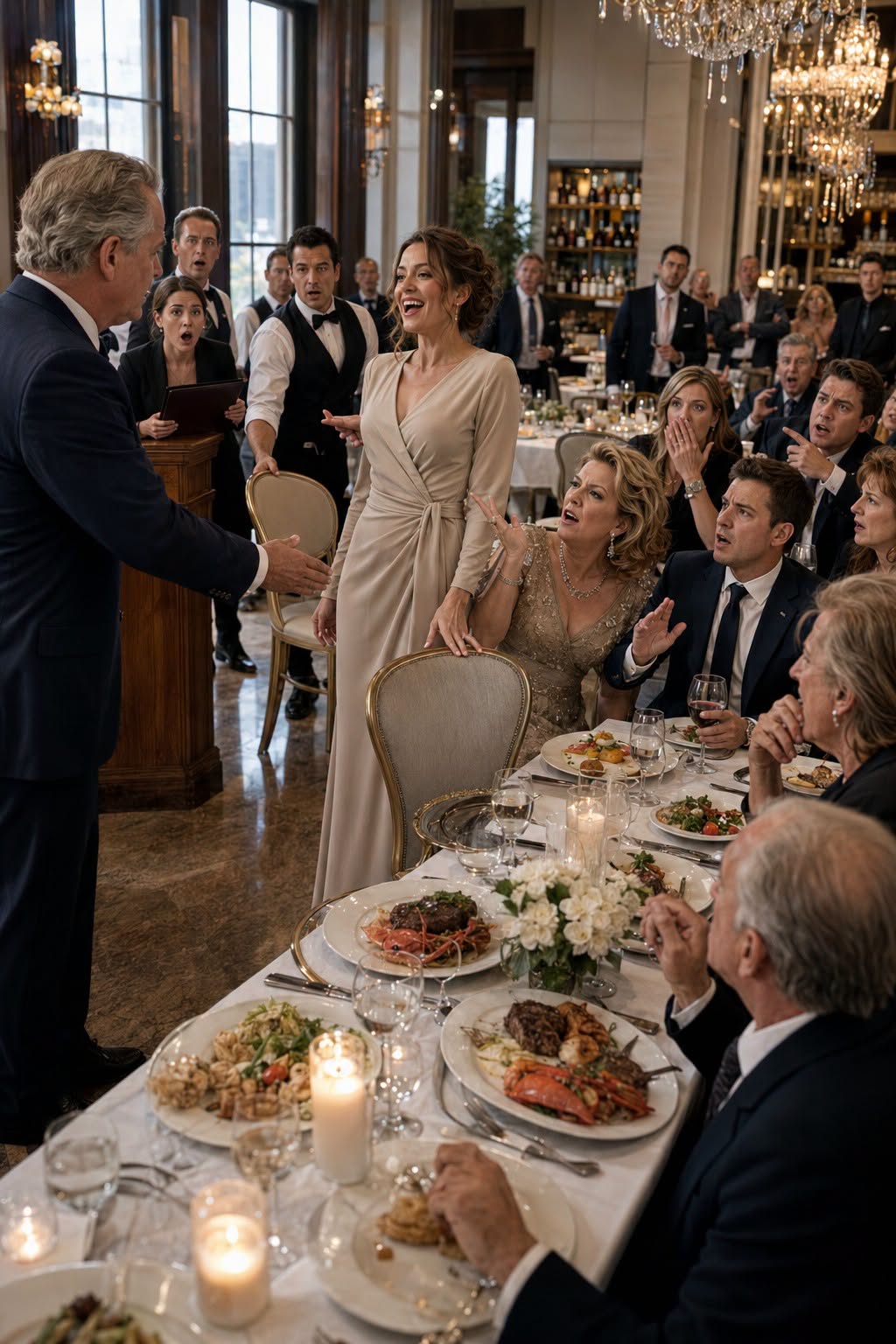
At The Aurelia, the host led me past the bar, past a wall of backlit bottles, toward the private dining area beneath a black iron chandelier. The Voss family sat at one long table dressed in cream linen and silver chargers. Place cards rested above every plate, their names engraved in looping script.
Advertisements
Cordelia sat at the head of the table in a pale gold suit, her hair twisted into a perfect silver knot. She looked like someone who had never raised her voice because she had spent a lifetime making other people do the shouting for her.
Her eyes found mine.
Then I saw it.
Every chair was filled.
Every place setting was taken.
There was no empty seat, no extra chair tucked against the wall, no apologetic server rushing to fix a mistake. The space where I should have been was simply bare, as if I had never existed in the plan.
Callan sat halfway down the table, his jaw tight, his eyes fixed on the fork beside his plate. His sister, Sable, lifted her wineglass and looked away. Her husband, Bram, smirked into his napkin. Callan’s father, Hollis, pretended to study the menu.
Cordelia tilted her head.
“Oh, Juliana,” she said, her voice carrying just enough for the whole table to hear. “How awkward. I suppose the staff misunderstood the count.”
Nobody believed that.
I looked at Callan.
He did not stand.
He did not ask a server for another chair.
He did not say, “That is my wife.”
Cordelia’s smile widened by the smallest cruel inch.
“Maybe the little diner down the street suits you better,” she added.
The table erupted.
Not loudly. That would have been too honest. It was worse than that. Polished laughter. Controlled laughter. The kind of laughter people use when they want humiliation to look like etiquette.
My face went hot first. Then cold.
I heard the crystal clink. I heard someone whisper, “Oh my God.” I heard Callan clear his throat and still say nothing.
For a second, I was twenty-two again, standing in a kitchen with a burn across my wrist and a chef telling me not to cry over pain unless it changed the ticket time.
So I didn’t cry.
I set my clutch under my arm, turned to the nearest server, and said, “Could you please ask Arlo Finch to come out?”
The server blinked.
Cordelia laughed softly. “Juliana, bothering the chef won’t create a chair.”
I looked at her.
“No,” I said. “It will create clarity.”
The server disappeared through the swinging kitchen door.
At the table, Cordelia’s smile stayed fixed, but something behind her eyes shifted. Callan finally looked up.
“Jules,” he murmured. “Don’t make this weird.”
That was the first time I almost laughed.
The kitchen doors opened.
Arlo Finch stepped into the dining room wearing a white chef coat, sleeves rolled to his forearms, a towel thrown over one shoulder. He had a scar near his left eyebrow from an old sauté pan accident and the kind of calm that comes only from surviving dinner rushes with twenty open tickets and one broken oven.
He scanned the room.
Then he saw me.
His whole face changed.
“Chef,” he said.
Not “Juliana.”
Not “Mrs. Voss.”
Chef.
The room went silent so fast I could hear the air conditioner hum.
Arlo crossed the floor, pulled a chair from a small round table near the wine cabinet, and placed it at the chef’s table facing the open kitchen.
“Your seat is ready,” he said.
Behind him, a line cook looked through the pass and nodded at me.
“Chef,” she said.
Then another voice from the kitchen echoed, “Chef.”
Cordelia’s smile vanished.
Callan’s fork slipped from his hand and hit the plate with a sharp, bright sound.
And for the first time all evening, I felt my heartbeat slow.
May you like



Because the Voss family had removed my chair.
But they had forgotten I had built the room.







