Chapter 5
### Part 5
Rehabilitation began with one impossible task.
“Touch your thumb to your index finger,” Dr. Sethi said.
I looked at her like she had asked me to lift the hospital.
My hand had been freed from the heavier brace that morning. It was swollen, stiff, and scarred, with thin surgical lines across the skin. The fingers that used to fly through arpeggios now trembled from the effort of being alive.
I tried.
Nothing happened.
My thumb moved halfway and stopped.
Pain shot across my palm.
My eyes filled.
Dr. Sethi did not pity me. I liked that about her.
“Again,” she said.
It reminded me of Ms. Pike.
So I tried again.
For the next several months, my life became tiny movements.
Bend.
Hold.
Release.
Lift.
Rest.
Ice.
Repeat.
There was no applause in hand therapy. No velvet curtain. No polished Steinway. Just a beige room that smelled like lotion and disinfectant, a plastic bin of therapy putty, rubber bands, warm towels, and a wall clock that moved too slowly.
My therapist, Jonah Reed, was a former baseball player with a soft voice and no patience for self-pity.
“You are allowed to be angry,” he told me during week three. “You are not allowed to quit.”
“I hate this,” I said.
“Good. Hate it while doing it.”
So I did.
I hated every second.
I hated squeezing foam blocks.
I hated tracing circles on a towel.
I hated the little wooden pegs I could not pick up.
I hated watching children on the internet play pieces I used to play before breakfast.
I hated that my left hand had become competent out of necessity while my right hand sat there like a stubborn stranger.
Some nights, I woke from dreams where I was onstage and my fingers melted into the keys.
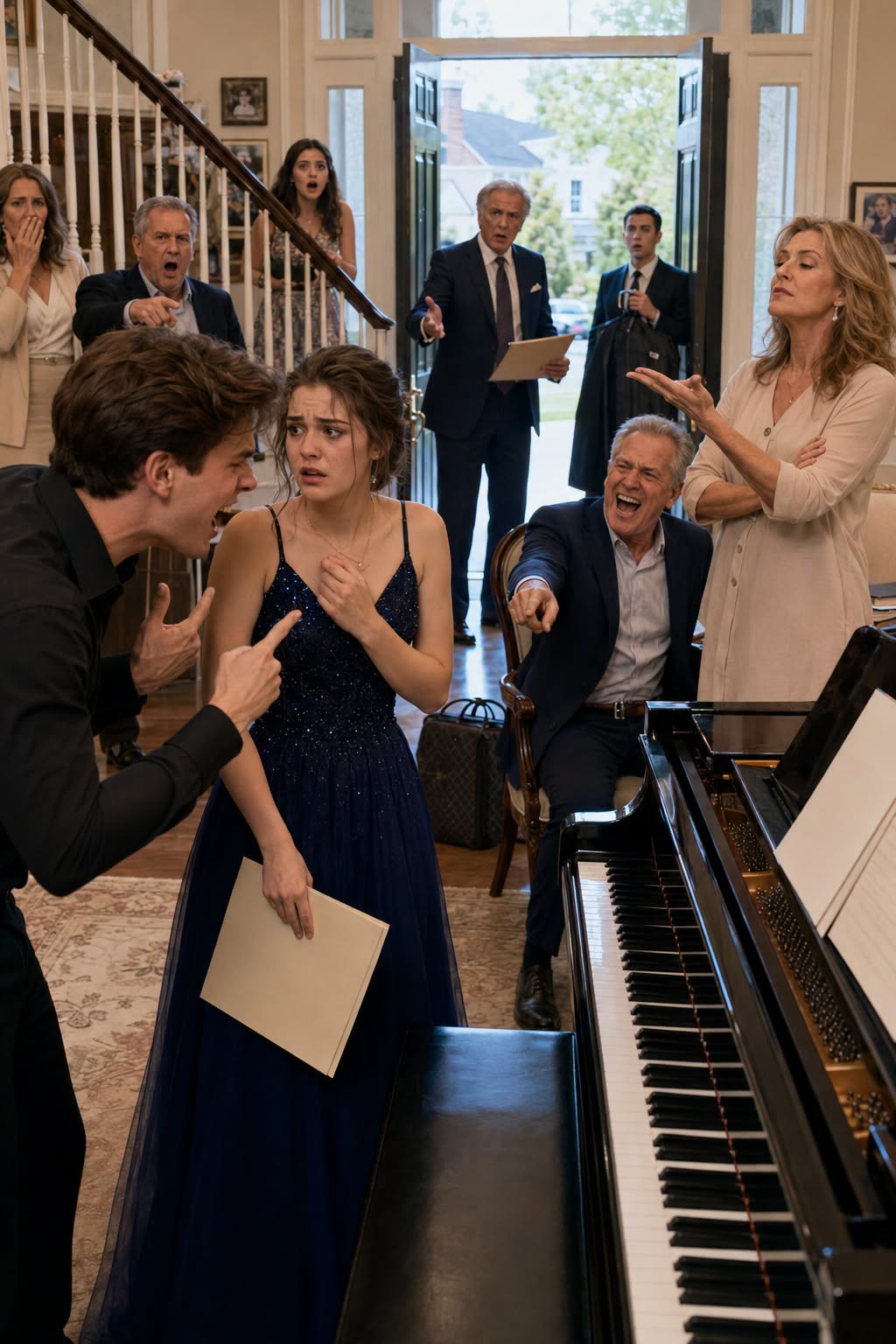
Other nights, I heard Dad laughing.
“Nobody cares about your dream.”
That sentence followed me into grocery stores, therapy rooms, elevators, showers, and sleep. It sat beside me while I paid bills. It leaned over my shoulder when I opened emails from Chicago. It whispered every time my hand failed to move.
Then one afternoon, Ms. Pike visited my apartment with a portable keyboard under one arm.
“No,” I said immediately.
She walked past me. “Yes.”
“I can’t play.”
“You can listen.”
She set the keyboard on my kitchen table between a stack of medical bills and a bowl of oranges.
My apartment was small, with thin curtains and a radiator that clanked at night. After the story spread, people from the music community had helped cover rent and treatment costs. Chicago deferred my admission. Grand Lakes created the resilience fund. Strangers sent cards. Children I had taught mailed drawings of pianos with giant hearts above them.
My family sent messages.
Different kind of messages.
Mom wrote, “Your father is not sleeping.”
Dad wrote once, “You are destroying this family over one mistake.”
Callum wrote, “I miss my sister.”
I blocked all three.
Ms. Pike plugged in the keyboard.
“Left hand only today.”
I stared.
“Mari,” she said. “Music is not punishment. Stop treating it like a room you are not allowed to enter until you are perfect.”
That hit something tender.
I sat down.
The keys were cheap and light, nothing like a grand piano. My right hand rested in its brace on a folded towel. My left hand hovered over middle C.
“What do I play?”
“Something ugly.”
I laughed despite myself. “What?”
“Play how you feel.”
So I did.
It was not beautiful.
It was not impressive.
It was low, uneven, angry. Three notes repeated until they sounded like footsteps down a hall. Then a cluster of dissonant chords. Then one high note, thin and lonely.
Ms. Pike sat across from me with tears in her eyes.
“That,” she said, “is honest.”
I cried then.
Not because I sounded good.
Because I sounded alive.
The legal case moved slower than recovery but cut deeper.
Detective Bell kept me informed. Prosecutors reviewed the video, medical records, destroyed documents, intercepted letters, Ms. Pike’s evidence, and the burn barrel recovery. My father hired an attorney who described him as “a concerned parent overwhelmed by family stress.” My mother claimed she had been emotionally controlled by him. Callum said he had “reacted impulsively.”
Nobody said the word they all meant.
Sabotage.
A civil attorney named Arden Frost took my case after Solomon introduced us. She had silver bracelets that clicked softly when she opened files and a stare that made people tell the truth faster than they wanted to.
“What do you want?” she asked me during our first meeting.
I expected her to mean money.
I said, “I want them to stop saying it was an accident.”
She nodded. “That we can do.”
She filed claims for assault-related damages, intentional interference with educational and professional opportunities, destruction of property, and emotional distress. The numbers were large. So large I felt dizzy looking at them.
Dad finally got scared enough to request mediation.
I almost refused.
Arden advised me to attend once.
“Not to forgive,” she said. “To hear what they are willing to admit when consequences are sitting across the table.”
The mediation room was on the twelfth floor of a downtown office building. It had gray carpet, a long table, a pitcher of water, and a view of the river cutting through the city like steel.
My parents arrived first.
Dad looked smaller than I remembered. He wore a suit but no confidence. Mom clutched tissues like props. Callum sat between them, pale, thinner, eyes red.
When I walked in, Mom stood.
“Baby,” she whispered.
I held up my left hand.
“Don’t.”
She sat down.
Dad looked at my right hand, still stiff, still marked.
For one second, shame crossed his face.
Then pride covered it.
“We never wanted to hurt you permanently,” he said.
Arden’s bracelets clicked as she opened her folder.
“That is an interesting opening statement.”
Callum started crying before anyone asked him anything.
“I’m sorry, Mari.”
I looked at him.
He was waiting for the old rhythm. His tears, my comfort. His collapse, my responsibility.
I did not move.
Dad leaned forward.
“You have to understand. We thought music was taking you away from us.”
I almost laughed.
“You stole fourteen opportunities from me.”
Mom whispered, “We were afraid.”
“Of what?”
No one answered.
Arden slid photocopies of the intercepted letters across the table.
The paper made a soft scraping sound.
“Afraid of this?” she asked. “Scholarships? Invitations? Recognition?”
Dad’s face reddened.
“She would have left.”
I felt something inside me settle.
There it was.
Not concern.
Ownership.
I looked at my father, this man who had called himself practical, protective, realistic.
“You did not want a daughter,” I said. “You wanted a captive audience.”
His mouth opened.
May you like



Nothing came out.
For the first time in my life, the silence belonged to me.







