Chapter 2
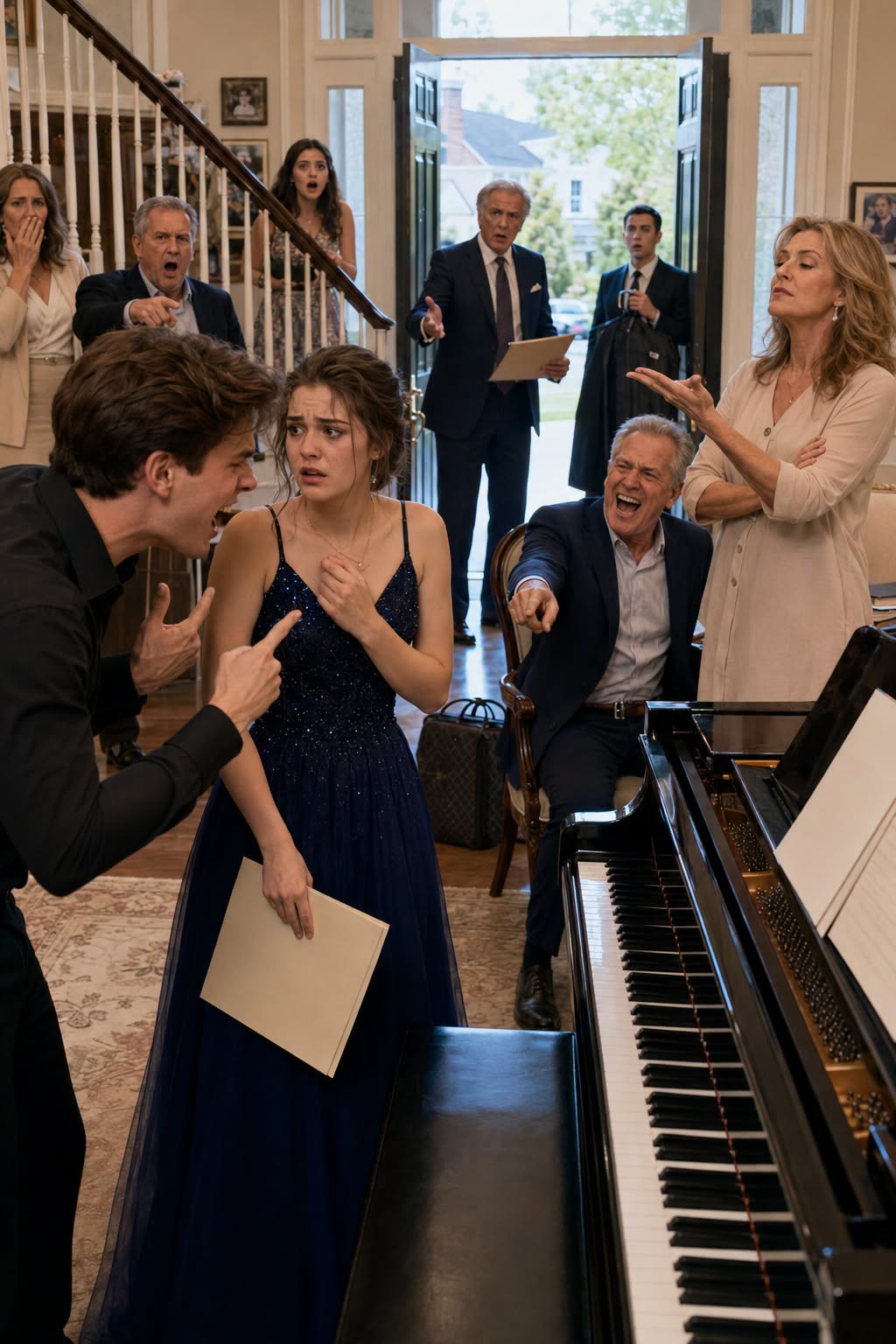
### Part 2
Callum did not invite him in.
He just stood there, blocking the doorway like a child caught stealing from a cash register.
The man on the porch knocked again, even though the door was open.
Three slow knocks.
Not impatient.
Certain.
My father rose from his chair so slowly the legs scraped against the tile.
“What are you doing here?” he asked.
The man was in his late sixties, maybe older, with silver hair brushed neatly back and a dark wool coat buttoned to his throat. His face looked familiar in the way old songs feel familiar before you remember the words. He carried a weathered violin case in one hand and a brown leather portfolio under his other arm.
Then he looked past Callum and saw me.
His expression warmed for half a second.
“Maribel Wren.”
His eyes dropped to my hand.
The warmth vanished.
“What happened?”
Dad stepped between us immediately. “She’s fine.”
The man ignored him like he had not spoken.
He walked straight into the kitchen, set the violin case carefully on a chair, and stood in front of me.
“May I see?” he asked.
His voice was gentle. That nearly broke me more than the pain.
I lifted my hand. My fingers looked wrong. Swollen, bent, already bruising under the skin.
The man inhaled once through his nose.
“Who did this?”
Callum laughed nervously. “She hit the table. She gets dramatic.”
The man turned his head toward him.
“No,” he said quietly. “She did not.”
The kitchen went silent.
Even the refrigerator seemed to pause.
He took my wrist carefully and looked at my fingers with a focus that made the pain feel more real. He did not squeeze. He did not move anything. He just studied the angle, the swelling, the way my middle and ring fingers trembled.
Then he whispered, “Compression trauma.”
I swallowed. “You know injuries?”
“I know musicians,” he said.
Dad’s jaw tightened. “This is family business.”
The man looked up slowly. “When someone destroys a musician’s hand, it stops being family business.”
My mother gripped the edge of the counter.
“Solomon,” she said, and the name landed like a dropped glass.
Solomon.
My memory finally opened.
Solomon Vale.
He had been one of the judges at a regional competition when I was sixteen. I had played Chopin in a borrowed black dress with sleeves too long for my arms. I came in second. Afterward, while everyone else rushed out, Solomon Vale shook my hand and told me, “You listen before you play. Do not lose that.”
I had never forgotten him.
“You judged my regional,” I said.
He gave me a sad smile. “I did.”
Dad looked furious. “You have no reason to be here.”
Solomon’s eyes did not leave my hand. “I had every reason.”
He opened the leather portfolio. Inside were programs, photographs, letters, printed schedules, and a thick packet clipped in silver. He removed a finalist list.
Grand Lakes Performance Competition.
Contestant 23: Maribel Wren.
Beside my name, someone had written in blue ink: “Priority review. International fellowship consideration.”
My eyes blurred.
“What is that?”
Solomon looked at me.
“You were not just playing for Chicago today.”
I felt my heartbeat change.
“What do you mean?”
“There were representatives coming from three conservatories. Chicago, Boston, and Vienna. Your recordings had already moved through private review.”
I stared at him.
Dad scoffed. “Private review? For her?”
Solomon did not look at him. “For her.”
The kitchen, the pancakes, the fake family photos, the smell of maple syrup, my mother’s trembling hand on the counter—everything suddenly became too bright.
“You mean today mattered more than they told me?” I asked.
Solomon’s face softened. “Today was supposed to be the door opening.”
My knees weakened.
I looked at my hand.
My right hand.
The hand that had practiced sixths until midnight. The hand that had learned Rachmaninoff on an out-of-tune church piano. The hand Grandma Odette used to cover with her own when I got frustrated.
Callum shifted behind Dad. “Nobody knew all that.”
Solomon turned toward him. “You knew enough.”
Callum’s mouth opened, then closed.
Dad folded his arms. “She injured herself. You’re making this dramatic.”
Solomon lifted his phone.
“I arrived five minutes before I rang the bell.”
My father froze.
“I was checking the address. My phone camera was recording because I had been filming the conservatory entrance for the committee earlier.”
Dad’s face changed first.
Not fear.
Calculation.
Solomon continued, “It caught enough through the glass beside your door.”
The room became airless.
He tapped the screen once.
The video was shaky, angled from his coat pocket, framed partly by the porch railing and the narrow side window. But it showed the kitchen.
It showed Callum grabbing my wrist.
It showed my body twisting.
It showed the table.
It captured my scream.
Then Dad’s laugh.
Then his voice.
“Nobody cares about your dream.”
My mother covered her mouth.
Not because she was horrified.
Because she had been caught.
Solomon locked the phone and slipped it back into his pocket.
“I have already backed it up,” he said. “The committee has a copy.”
Dad lunged one step forward. “You had no right.”
Solomon’s voice hardened. “Neither did you.”
I barely heard the rest because pain rolled up my arm in waves. My vision narrowed. My fingers burned, then throbbed, then went cold.
Solomon took out his phone again.
“I need an ambulance,” he said.
Dad snapped, “That’s not necessary.”
“It is necessary.”
“She can go to urgent care later.”
Solomon looked at him like he was studying a stain. “If those fingers are not treated immediately, she may lose professional function.”
Lose professional function.
The phrase sounded sterile.
Polite.
It meant my life.
Mom finally spoke, her voice small. “Maybe it’s just swelling.”
I looked at her.
For the first time, I did not see my mother. I saw a woman who would have watched me ice my ruined hand at her kitchen sink while my future disappeared.
The ambulance arrived eight minutes later.
I remember the sound before anything else. The siren coming closer. The slap of paramedic boots on the porch. A woman asking, “Ma’am, can you sit down?” A man cutting away the cuff of my sleeve because my hand was swelling too fast.
“How did this happen?” the female paramedic asked.
My father opened his mouth.
Solomon said, “There is video.”
The paramedic’s eyes flicked toward him, then back to me.
“Okay,” she said softly. “We’re going to take care of you.”
They splinted my hand in the kitchen where I used to do homework while Mom cooked dinner. The same table where Callum had eaten birthday cake and I had filled out college applications. The same table now had my lucky music-note keychain lying beside a smear of syrup.
As they wheeled me out, Dad followed us to the porch.
His face had changed again.
Soft now.
Concerned.
Fake.
“Mari,” he said. “Let’s not make this bigger than it has to be.”
I looked at him from the stretcher.
For twenty-four years, I had wanted my father to sound worried about me.
Now that he did, I felt nothing but cold.
Callum stood behind him, pale and sweating.
Mom stayed in the doorway, arms wrapped around herself.
Solomon climbed into the ambulance with me.
“You don’t have to come,” I whispered.
“Yes,” he said. “I do.”
The doors closed.
The siren started.
For the first time since Callum crushed my hand, I was away from them.
No Dad.
No Mom.
No brother.
Just me, Solomon Vale, and the terrifying possibility that six years of my life had ended in less than five seconds.
I stared at my swollen fingers.
They looked like they belonged to someone else.
Then Solomon said something that made me turn my head.
“Maribel, do you know why I came to your parents’ house today?”
I shook my head.
He opened the black violin case.
There was no violin inside.
Only a blue folder thick with documents.
“I came to tell you the committee had already made a decision.”
My throat tightened.
“What decision?”
May you like



His eyes shone.
“You were our highest-scoring finalist before you ever walked onstage.”







