Chapter 3
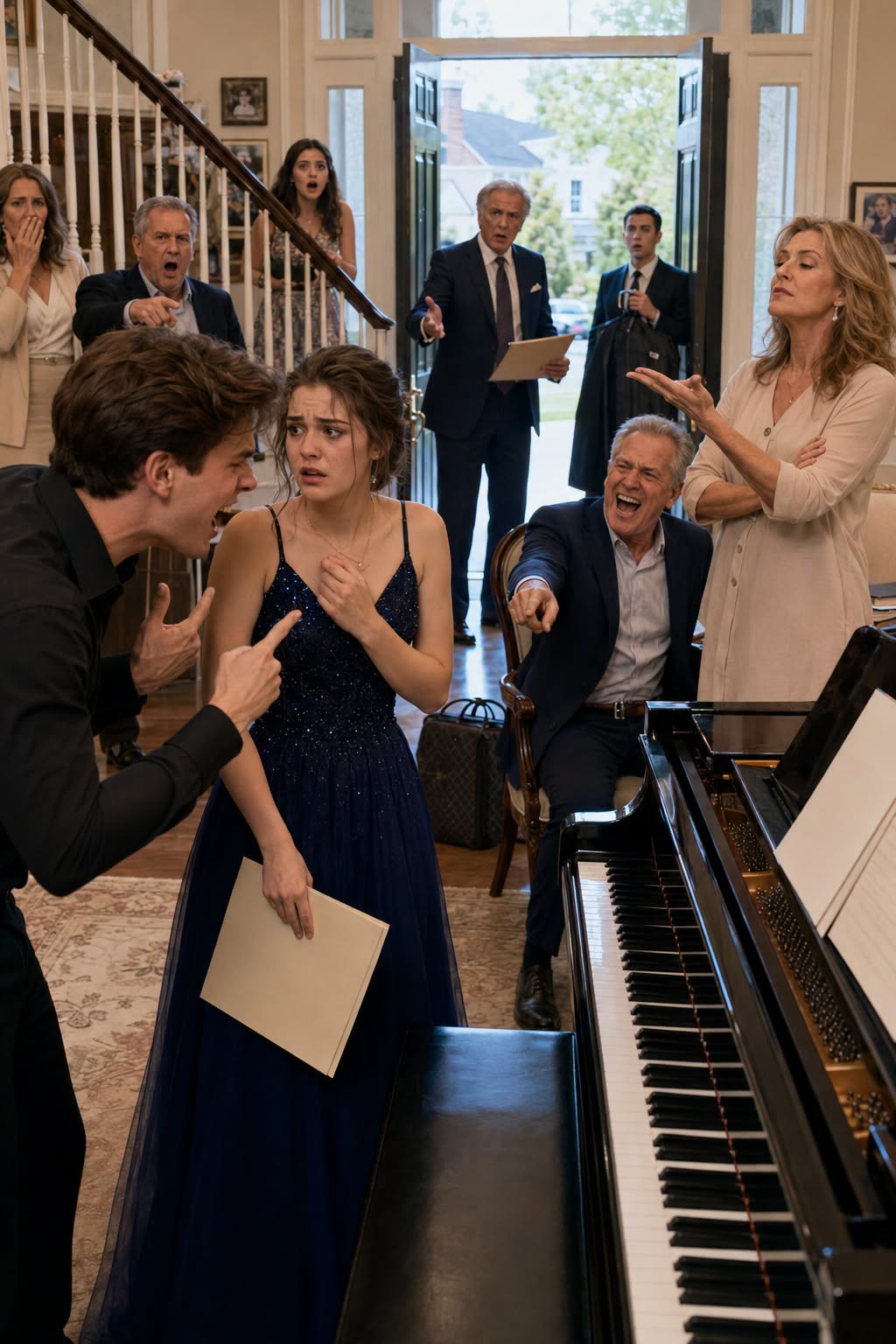
### Part 3
At the hospital, everything smelled like antiseptic, cold coffee, and wet winter coats.
The emergency room lights were too bright. Every sound seemed sharpened—the squeak of wheels, the beep of monitors, a child coughing behind a curtain, nurses calling names over the desk. My right hand rested on a pillow wrapped in a temporary splint, and I kept staring at it as if it might become my hand again if I watched long enough.
Solomon sat in the chair beside my bed, his wool coat folded over his knees, the blue folder balanced carefully on top.
“You said I was the highest-scoring finalist,” I whispered.
He nodded.
“But I had not played today.”
“You had played for years,” he said.
I looked at him.
He opened the folder and turned it toward me.
Inside was an acceptance packet.
Not a little letter.
Not a polite “congratulations.”
A full packet.
Three years of tuition. Master classes. Housing support. Summer residencies in Europe. Invitations to perform in student showcases. Notes from faculty reviewers. A page that made no sense at first because it was too large for my life.
International Young Artists Fellowship.
My vision blurred.
“I don’t understand.”
Solomon smiled sadly. “That is because nobody told you how good you were.”
I let out a laugh that broke halfway through. “People told me I was okay.”
“The wrong people told you that.”
I tried to wipe my face with my left hand, clumsy and angry. “Why didn’t they tell me before today?”
“Some of this was meant to be announced at the ceremony. Some was still confidential. But your teacher kept sending recordings. Community recitals. Benefit concerts. Retirement home performances. Your children’s workshop last fall.”
I stared at the page.
“You saw those?”
“The committee saw them. Chicago saw them. Boston saw them. Vienna saw them.”
For years, I had played in half-empty church basements and senior centers where the piano bench squeaked and someone always coughed during the quiet parts. I played at the children’s hospital once a month because one little boy with leukemia liked Debussy and asked me if clouds had music. I played at fundraisers where nobody knew my name and people talked over the first movement until they realized the room had changed.
I thought nobody noticed.
Solomon tapped the folder gently. “The right people noticed.”
That should have comforted me.
Instead, it hurt.
Because every time my family mocked me, every time Dad asked when I would stop wasting money, every time Callum called my rehearsals “finger gymnastics,” I had believed part of them.
A doctor came in wearing purple glasses and a serious expression.
“I’m Dr. Mira Sethi,” she said. “I’m the hand specialist on call.”
The words “hand specialist” made my stomach drop.
She removed the temporary splint with such careful hands I almost cried from gratitude. She studied every finger, ordered X-rays, then returned with a tablet held against her chest.
“I’m going to be honest with you,” she said.
I nodded because my voice had disappeared.
“The middle and ring fingers have multiple fractures. There is significant swelling. There may be small bone fragments we need to stabilize surgically.”
Solomon leaned forward.
Dr. Sethi continued, “But the tendons appear intact.”
I blinked. “What does that mean?”
“It means this is serious. It means surgery. It means months of rehabilitation. It means pain, frustration, stiffness, and a recovery process you will probably hate.”
She paused.
Then her face softened.
“But it does not mean your career is over.”
I burst into tears.
Not pretty tears.
Not movie tears.
Ugly, silent, shaking tears that seemed to come from the bottom of my ribs.
Solomon looked toward the ceiling and pressed his fingers against his mouth.
Dr. Sethi waited, then said, “The most important thing is that you came immediately. Another hour or two without proper treatment could have changed the outcome.”
The room tilted again.
Another hour or two.
If Solomon had not arrived, I would have stayed at that house.
Mom would have wrapped my hand in a dish towel and said, “Let’s not be dramatic.”
Dad would have told me to lie down.
Callum would have vanished.
And by the time I realized the damage was permanent, they would have shrugged and called it unfortunate.
Not cruel.
Not planned.
Unfortunate.
Dr. Sethi explained surgery, pins, immobilization, therapy, follow-ups. I heard every third word. Solomon asked the questions I could not form. When she left, the room became quiet except for the monitor beside me.
Then Solomon’s phone rang.
He glanced at the screen.
“Maribel,” he said gently. “This is for you.”
I frowned. “Who is it?”
He pressed the phone to my left hand.
A woman’s voice came through, warm and steady. “Maribel? My name is Vivienne Aster. I chair the Grand Lakes committee.”
I sat up too fast and pain flashed up my arm.
“I’m sorry,” I said automatically. “I can’t perform.”
There was a pause.
Then she said, “We know.”
My face burned. “I worked so hard. I was ready. I swear I was ready.”
“I believe you.”
“I can send recordings. I can—”
“Maribel,” she said softly. “Listen to me.”
I stopped.
“You earned this long before today.”
The room seemed to hold its breath.
“What?”
“The committee met after reviewing the video Solomon sent and after confirming your medical emergency. We voted unanimously to withdraw the live performance requirement.”
My lips parted.
“I don’t understand.”
“You do not need to perform today. We already know how you play.”
I looked at Solomon. His eyes were wet.
Vivienne continued, “The scholarship is yours. The fellowship recommendation remains active. Chicago has confirmed your seat will be deferred until you are medically cleared.”
I covered my mouth with my left hand.
“You’re serious?”
“Yes.”
I could not speak.
Then she added, “One more thing. We will be naming a need-based resilience fund after this year’s incident. Not as pity. As a statement.”
My throat tightened.
“What statement?”
“That no artist’s future should depend on whether their own family chooses to protect them.”
The call ended a minute later.
I sat there holding Solomon’s phone, shaking.
For six years, I had imagined winning would feel like a bright door swinging open.
Instead, it felt like someone had dragged me out of a burning room and told me the sky was still there.
A nurse stepped in, looking uncomfortable.
“Miss Wren?”
“Yes?”
“There are two detectives outside.”
My stomach turned. “Already?”
She nodded.
“They’re asking to speak with you before surgery, if you’re able.”
Solomon stood. “About the assault?”
The nurse hesitated.
“Not only that.”
A detective entered first. She was tall, with dark cropped hair and a gray coat that still had snow melting on the shoulders. She introduced herself as Detective Nadia Bell. Her partner stayed near the door, quiet and watchful.
“I know this is a lot,” Detective Bell said. “But something happened at your parents’ house after you left.”
I felt my body go cold.
“What did they do?”
She placed a clear evidence bag on the bed.
Inside was a notebook.
My notebook.
The green spiral one Grandma Odette gave me when I was twelve. The cover was stained and blackened around the edges. A corner had burned away. I could still see my own handwriting through the plastic.
Tiny notes.
Melodies.
Chords.
First attempts at songs I never showed anyone.
“My neighbor called 911,” Detective Bell said. “Smoke coming from a burn barrel behind the garage.”
I stared at the notebook.
“Dad burned my music?”
Her expression hardened. “He tried.”
Solomon whispered, “He was destroying evidence.”
Detective Bell opened her folder.
“Not just evidence. We recovered damaged certificates, recital recordings, old programs, photographs, recommendation letters, and several unopened envelopes addressed to you.”
My chest tightened.
“Unopened?”
She slid one photocopy toward me.
I read the first line.
“Dear Ms. Wren, congratulations…”
The date was five years earlier.
I had never seen it.
She placed another copy beside it.
Then another.
Then another.
My breath started coming too fast.
“How many?”
Detective Bell’s voice lowered.
“Fourteen so far.”
Solomon went very still.
I looked at him. “What does that mean?”
He rubbed his forehead like he had suddenly aged ten years.
“It means,” he said, “that for years, we thought you were declining opportunities.”
The room blurred around the edges.
“I never declined anything.”
Detective Bell nodded.
“We know.”
My right hand throbbed under the splint.
But the pain in my chest was worse.
May you like



My family had not just tried to stop me that morning.
They had been stopping me for years.







