part 10
PART 10
Lauren did press charges.
Not for revenge.
For record.
The hospital photographs mattered.
The police report mattered.
Margaret’s statements on the porch mattered.
The kettle mattered.
For the first time in her life, Margaret Sterling learned that cruelty did not become private simply because it happened in a kitchen.
The court issued a protective order.
Margaret could not enter the house.
She could not contact Lauren.
She could not claim residence.
She moved into a rented townhouse across town and told friends she had chosen to downsize.
No one believed her completely.
Some lies survive because people are polite.
Not because they are convincing.
Ethan moved into a small apartment near his office.
For six weeks, Lauren did not meet him without Naomi present.
At first, he came with apologies.
Then explanations.
Then shame.
Lauren listened to all of them and accepted none as payment.
Finally, one afternoon, he said the only sentence that sounded like a beginning.
“I chose peace with her over safety for you.”
Lauren looked at him.
“Yes.”
He cried then.
Not loudly.
Not in a way that asked her to comfort him.
Just enough to show that the truth had finally passed through pride and reached bone.
Their marriage did not heal quickly.
Some cracks do not close because someone says sorry.
Some houses need rewiring after a fire.
Some love needs distance before it can become honest.
But Ethan kept showing up.
Therapy.
Legal compliance.
Public correction.
Written statements to relatives.
He told every person who had ever heard Margaret call the house hers that the house belonged to Lauren.
Not us.
Not the family.
Lauren.
That mattered more than flowers.
More than tears.
More than any dramatic apology.
As for the house, Lauren changed it.
Margaret’s silk curtains came down.
The formal sitting room became a veterans’ legal assistance office once a month.
The guest bedroom became a quiet space for military spouses in crisis.
The kitchen was remodeled last.
Lauren refused to keep the same counters where Margaret had thrown the water.
General Hale visited once after the renovation.
He stood in the doorway and looked at the bright new kitchen.
“Feels different.”
Lauren smiled faintly.
“It is.”
Years later, people in the neighborhood still talked about the morning the military convoy arrived at Briar Hollow Drive.
They remembered the soldiers in formation.
The general on the walkway.
The police by the curb.
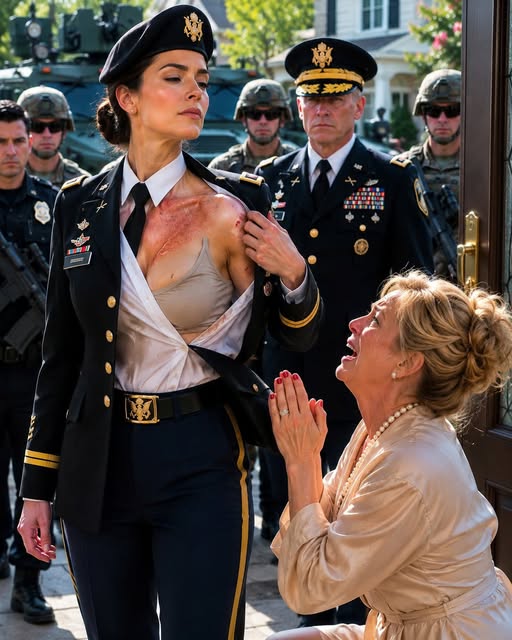
The daughter-in-law in uniform with a burn on her shoulder and a folder in her hand.
They remembered Margaret whispering, “You own this house?”
They loved the reversal.
The humiliation.
The perfect collapse of a woman who had mistaken cruelty for authority.
But Lauren remembered something else.
She remembered standing barefoot outside the front door the day before, skin burning, heart breaking, realizing that the house she owned had still not felt safe.
And she remembered walking back in with witnesses, not because she needed power, but because she deserved protection.
That was the lesson.
Ownership is not only a name on a deed.
It is the right to stand in your own doorway without fear.
The right to say who enters.
The right to remove anyone who turns shelter into a weapon.
Margaret had thrown scalding water and called Lauren a useless beggar.
May you like



The next morning, Lauren returned in uniform with a general, police officers, a lawyer, and the truth.
And from that day forward, no one ever stood inside Lauren Hayes’s house and forgot whose name was on the deed.







