Chapter 8
### Part 8
A year after the day they told Mia to pack, I stood in her doorway and watched her tape glow-in-the-dark stars to the ceiling.
She was thirteen now, taller than my shoulder, all elbows and opinions and half-finished art projects. Her room had become more hers than ever. Purple curtains. A corkboard covered in ticket stubs and photos. Stacks of books by the bed. Sneakers kicked under the desk.
The gray hoodie still hung on her chair.
She caught me watching and rolled her eyes.
“Mom, you’re doing the emotional face again.”
“I am not.”
“You are.”
“I’m admiring the tape job.”
She looked up at the crooked stars. “It’s terrible.”
“It has character.”
She laughed.
That sound meant more to me than any apology Patrice could have given.
Not that Patrice gave one.
She tried, months later, to send something shaped like an apology through Caleb’s aunt. It included phrases like “emotions were high” and “everyone made mistakes” and “we never meant for Mia to feel unsafe.”
Mia read it because we let her decide.
She handed it back after one paragraph.
“That’s not an apology,” she said. “That’s a fog machine.”
Caleb and I stared at her.
Then Caleb laughed so hard he had to sit down.
She was right.
It was not an apology. It was an attempt to make the room cloudy enough for everyone to walk back to their old positions.
We didn’t.
Brooke had the baby, a little girl. I heard she was healthy. I was glad for that in the distant way you can be glad for a child without reopening a door to adults who used children as leverage.
Patrice and Leonard still helped her. A lot.
Their retirement plans changed. Their quiet evenings disappeared. Their house filled with toys, laundry, noise, and the constant pressure of Brooke needing just one more thing. Sometimes relatives hinted that Caleb should “soften” now that enough time had passed.
He always gave the same answer.
“No.”
No explanation.
No debate.
Just no.
That one word became easier every time he used it.
Our marriage changed too.
Not because everything was perfect afterward. It wasn’t. There were hard conversations. There were apologies between us. I told Caleb how lonely I had felt watching his family take and take while I was expected to be gracious about it. He told me how ashamed he felt for mistaking endurance for goodness.
We did not fix six years in one night.
But we started telling the truth without flinching.
That made all the difference.
One Friday evening, Caleb came home with a frame.
Inside was a printed copy of our deed.
I stared at him. “You are not hanging that in the living room.”
He grinned. “Not the living room.”
“Caleb.”
He walked down the hall and held it up outside Mia’s room.
She came out, saw it, and burst out laughing.
“That is so weird.”
“It’s symbolic,” he said.
“It’s extremely Dad.”
He hung it inside our bedroom closet instead, where nobody else would see it. Not as a trophy. Not as a threat. Just as a reminder.
Some lines are worth putting in writing.
That night, we ordered pizza and ate on the balcony, the three of us squeezed around a tiny table that wobbled if anyone breathed too hard. Cars moved below us. Someone’s dog barked. The summer air smelled like rain on hot pavement.
Mia leaned her head against Caleb’s shoulder.
“Dad?”
“Yeah?”
“Do you miss them?”
He looked out over the parking lot for a while.
“I miss who I kept hoping they’d become,” he said. “But I don’t miss how they made us feel.”
Mia nodded like that made sense to her.
It made sense to me too.
People talk about forgiveness like it is the highest form of peace. Maybe sometimes it is. But for me, peace was not opening the door again. Peace was watching my daughter sleep without wondering who might make her feel disposable. Peace was a Saturday with no emergency calls. Peace was Caleb laughing without his phone lighting up beside him.
Peace was our condo staying ours.
A few weeks later, Patrice sent a birthday card for Mia.
No return address, but we knew the handwriting.
Inside was a gift card and a note that said, “Grandma loves you. I hope one day you understand.”
Mia read it twice.
Then she placed the gift card on the table and said, “I do understand.”
She threw the note away herself.
We donated the gift card to a school supply drive.
That was the ending Patrice never expected. No screaming. No begging. No dramatic reunion. Just a child who had learned her room could not be taken by guilt, and parents who had finally learned that protecting peace sometimes means disappointing people who depend on your silence.
So no, Caleb did not regret calling the police.
He did not regret cutting off the money.
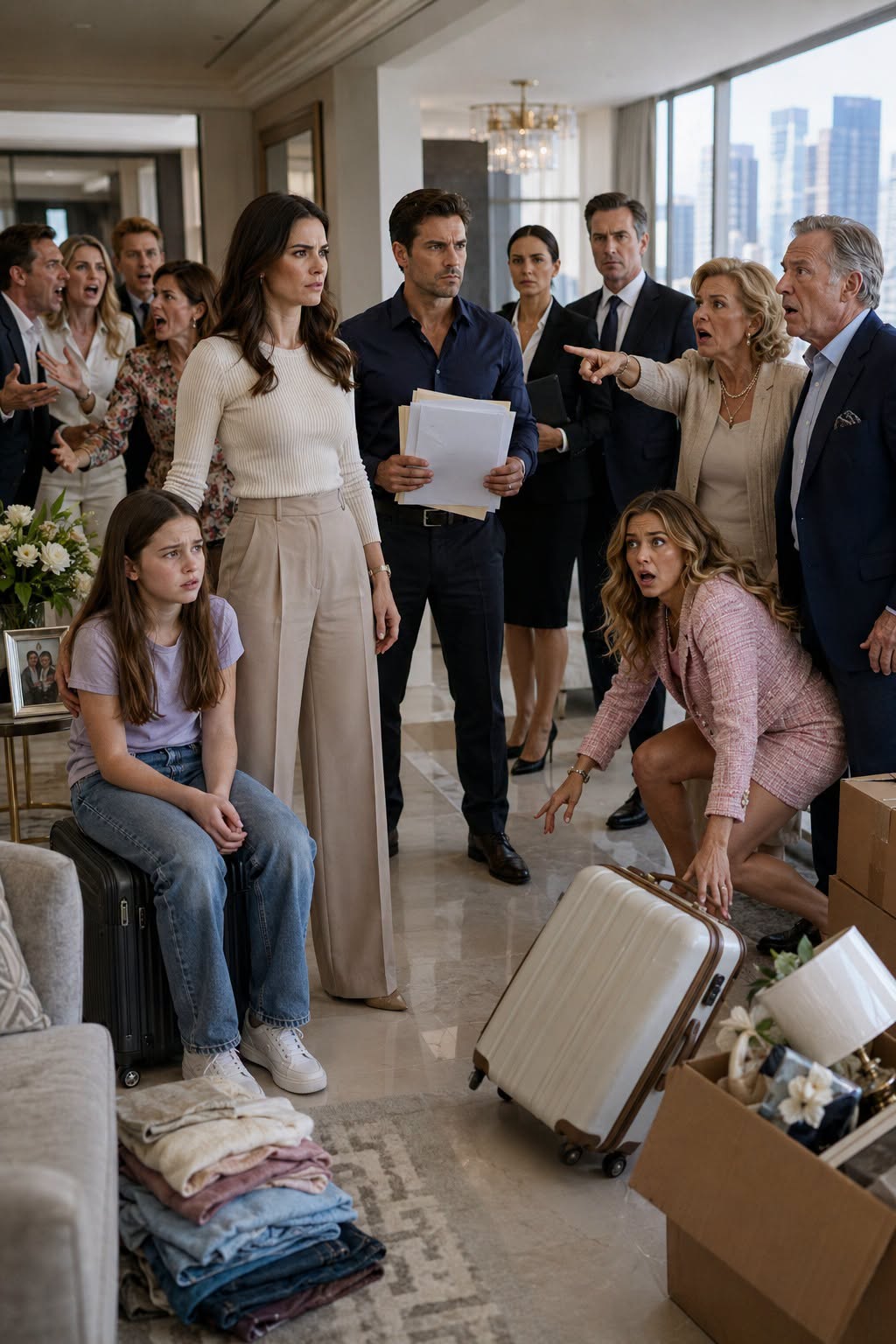
I did not regret standing in that doorway while Brooke’s boxes went back into the truck.
And Mia?
She still lives here.
In her room.
Under her crooked glow-in-the-dark stars.
May you like



Exactly where she belongs.
THE END!







