Chapter 5
### Part 5
The officers arrived seven minutes later.
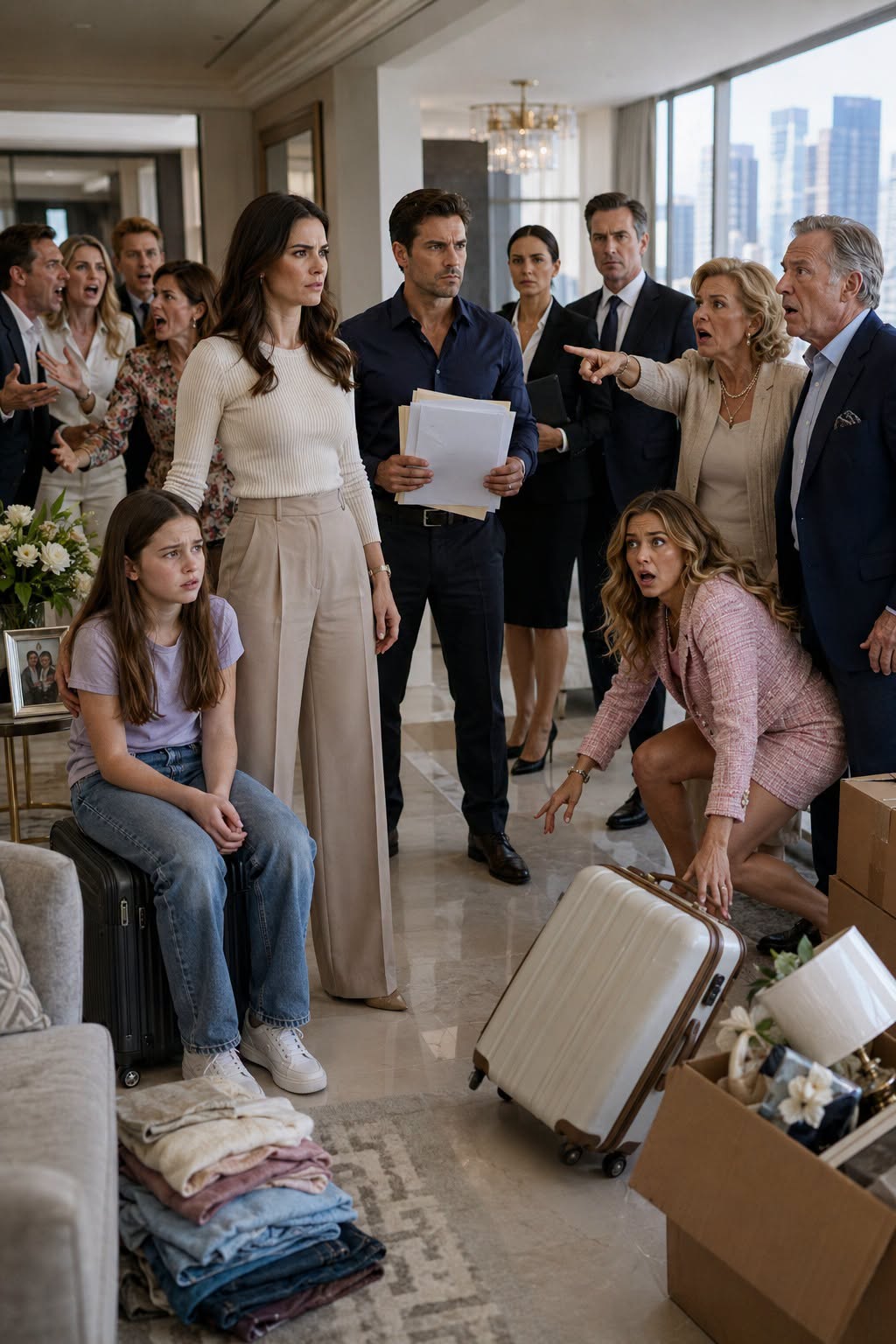
Seven minutes can feel very long when you are standing in your own living room beside another woman’s boxes while your in-laws pretend the law is being rude to them.
Nobody moved much during that time.
Brooke whispered to her friend, who suddenly remembered an urgent appointment and backed toward the door with the lamp still in her hands. Leonard kept looking at the deed copy like it might transform into something more convenient if he frowned hard enough.
Patrice paced.
“This is disgusting,” she muttered. “Calling police on family. What kind of people do that?”
“The kind whose child was told to pack,” Caleb said.
She stopped pacing.
I took Mia into the kitchen and poured her a glass of water. Her hands shook when she lifted it. I wrapped both of mine around hers until the glass steadied.
“Is Dad mad at me?” she whispered.
I stared at her.
“No, baby. Never.”
“He looks scary.”
“He’s scared too,” I said.
Her eyebrows pulled together.
“Grown-ups get scared?”
“All the time.”
She looked toward the living room. “He’s not yelling.”
“No,” I said. “Your dad gets quiet when something really matters.”
The knock came before she could answer.
Two officers stepped inside after Caleb invited them in. A woman with a tight ponytail and a man with tired eyes who looked like he had spent most of his career listening to people explain why their bad decisions were technically misunderstandings.
The female officer asked who owned the condo.
“I do,” I said.
I gave her my ID. Caleb handed over the deed copy and a property tax statement he had printed from our files. Because, of course, he had brought documentation. Even in fury, Caleb packed evidence.
The officer looked through it, then asked what happened.
I told her.
I kept my voice steady, but my hand stayed on Mia’s shoulder.
“They came in without permission. My daughter let them in because they’re family and she thought we knew. They brought boxes and moving items. They told her she didn’t live here anymore and instructed her to pack her belongings so Brooke’s children could use her room.”
The male officer looked at Brooke. “Is that accurate?”
Brooke’s face twisted. “That makes it sound so harsh.”
“Is it accurate?” he repeated.
Patrice stepped forward. “This was a family housing discussion.”
The female officer looked around at the boxes. “With a moving van?”
Patrice flushed.
Leonard cleared his throat. “We believed Caleb had the authority to make decisions about the property.”
Caleb’s laugh was soft and empty.
“No, you didn’t. You believed you could pressure a twelve-year-old before I got home.”
The female officer looked at Mia, and her expression softened.
“Sweetheart, did anyone tell you to pack your room?”
Mia nodded.
“Can you say who?”
Mia’s fingers tightened around mine. “My grandma said I didn’t live here anymore. My aunt said her boys needed the closet.”
Brooke covered her face.
Not because she was sorry. I knew that by then.
Because Mia had said it out loud in front of uniforms.
The officers told them they needed to remove their belongings and leave.
Patrice made one last attempt.
“My son is making a terrible mistake because his wife has poisoned him against us.”
The male officer said, “Ma’am, you need to leave the residence.”
That was all.
No debate. No family tree. No emotional history.
Just leave the residence.
I cannot explain the satisfaction of watching entitlement meet a sentence it could not guilt-trip.
Brooke’s friend grabbed the lamp and practically fled. Leonard carried the kitchen box out first. Then the bins. Then the suitcase. Brooke moved slowly, crying now, one hand on her belly, waiting for someone to feel bad enough to stop the process.
No one did.
Patrice paused at the doorway.
“You’re choosing her over your family,” she said to Caleb.
He looked at Mia.
Then at me.
Then back at his mother.
“I’m choosing my family.”
Patrice’s face changed.
For years, she had used that word like a leash. Family meant her. Family meant Brooke. Family meant Caleb’s duty to the people who raised him.
This time, the word did not come back when she called it.
She left.
When the door closed, Mia burst into tears.
Not loud. Not dramatic. Just the kind that came from a body finally realizing it was safe enough to fall apart.
Caleb dropped to his knees and held her.
“I’m sorry,” he said into her hair. “I am so sorry they made you think this could happen.”
Mia clung to him. “I started packing.”
“I know.”
“I didn’t want to be bad.”
“You were not bad,” he said, his voice breaking. “They were wrong.”
I knelt beside them and wrapped my arms around both of them. For a few minutes, we stayed there on the hallway floor, surrounded by the empty spaces where Brooke’s boxes had been.
Later, we unpacked Mia’s duffel together.
Her shirts went back into drawers. Her books went back on the shelf. Her gray hoodie went onto the back of her chair like a flag.
At dinner, nobody was very hungry, so we ate grilled cheese and tomato soup under the warm kitchen light.
Mia asked if Grandma would come back.
Caleb put his spoon down.
“No,” he said. “Not unless we say she can.”
“And if she says she’s sorry?”
He looked at me before answering.
May you like



“Sorry does not unlock the door.”
That was the first night our condo felt smaller and stronger at the same time.







