Chapter 7
PART 7 — The Last Plate
Three years later, Vincent Callahan returned to the restaurant where he had been poisoned.
Not for revenge.
That had already been handled long ago through channels Nora preferred not to ask about and Vincent no longer discussed in the kitchen.
He returned because the building had changed ownership. The old private dining room had been stripped, repainted, renamed, and reopened as an upscale restaurant with lake views and too many candles.
Nora went with him.
Not because he needed protection.
Because he asked.
They arrived on a cold October evening. Vincent wore a dark overcoat. Nora wore a deep green dress and a wool wrap, her hair pinned with the silver clip that had belonged to her grandmother.
The manager recognized Vincent and went pale.
Vincent did not threaten him. He simply requested the corner table.
The same corner.
Nora noticed.
“You sure?”
“No,” Vincent said. “But I’m ready.”
They sat.
The restaurant moved around them in soft clinks and low voices.
For a while, Vincent looked at the table and said nothing.
Nora reached across and touched his hand.
“Same rules,” she said.
His eyes lifted.
“I eat first?” he asked.
“If you want.”
He smiled faintly.
The waiter brought bread.
Nora tore a piece, buttered it, and ate.
Vincent watched her, not with terror this time, but with memory.
Then he took bread for himself.
He ate.
Nothing dramatic happened.
No thunder. No collapse. No ghost leaving his body in a visible rush.
Just a man eating bread at a table where fear had once taken his life apart.
The main course came.
Braised short ribs.
Nora had not known he ordered them until the plate arrived.
She looked at him sharply.
“Vincent.”
“I chose it.”
His hand was steady, but his eyes were not untouched by the past.
Nora leaned back.
“Take your time.”
He cut into the meat.
Lifted the fork.
Paused.
For one second, the old room returned. The hospital. The monitors. The choking terror. The endless months of sealed packets and trembling hands.
Then he looked at Nora.
She was not pushing him. Not pitying him. Not performing strength for him.
She was simply there.
He ate.
The bite was small.
Then another.
Then another.
He finished half the plate, then set down his fork.
“That’s enough,” Nora said.
He nodded.
Outside, Lake Michigan was black beneath the city lights.
Vincent looked around the restaurant.
“For a long time,” he said, “I thought this was the room where my life ended.”
Nora squeezed his hand.
“It wasn’t.”
“No.” He looked at her. “It was the room before the kitchen.”
Years later, people would tell stories about Vincent Callahan.
Some true. Many exaggerated. Some dark enough that Nora would leave the room rather than listen.
But the people who really knew him understood the more important story was not about enemies, money, or power.
It was about the year he nearly disappeared inside his own fear.
It was about the maid from New Jersey who walked into a Chicago mansion with a duffel bag and grandmother’s recipes.
It was about beef stew on a stormy night.
Eggs cooked low and slow.
A fork lifted with shaking hands.
A traitor exposed.
A kitchen brought back to life.
And a man who learned, bite by bite, that trust could be rebuilt in the most ordinary way imaginable.
Not through speeches.
Not through promises.
Not through force.
Through someone standing at a stove and saying, without saying it:
You are safe enough to eat.
On the fifth anniversary of Collins Kitchen, Nora opened a public location in Chicago. Not a luxury restaurant. Not a place with white tablecloths and silent waiters.
A warm place.
Brick walls. Wooden tables. Big bowls. Fresh bread. Good coffee. Food that tasted like somebody cared whether you made it through the day.
Above the kitchen door, she hung a small framed photograph of her grandmother.
Under it, in her grandmother’s handwriting copied from an old recipe card, were the words:
Feed people like it matters.
Vincent came before opening, while the chairs were still upside down and Nora was pretending not to be nervous.
He stood in the center of the room and looked around.
“She would be proud,” he said.
Nora looked at the photograph.
“I hope so.”
“I know so.”
At seven, the doors opened.
The first customers came in from the cold: nurses after a long shift, a father with two little girls, an elderly man who ate alone but smiled after the first spoonful of soup.
Nora moved through the room greeting people, adjusting plates, correcting temperatures, laughing when something went wrong because kitchens were living things and living things never behaved perfectly.
Vincent sat at a corner table near the back.
Not because he needed distance.
Because from there, he could see her.
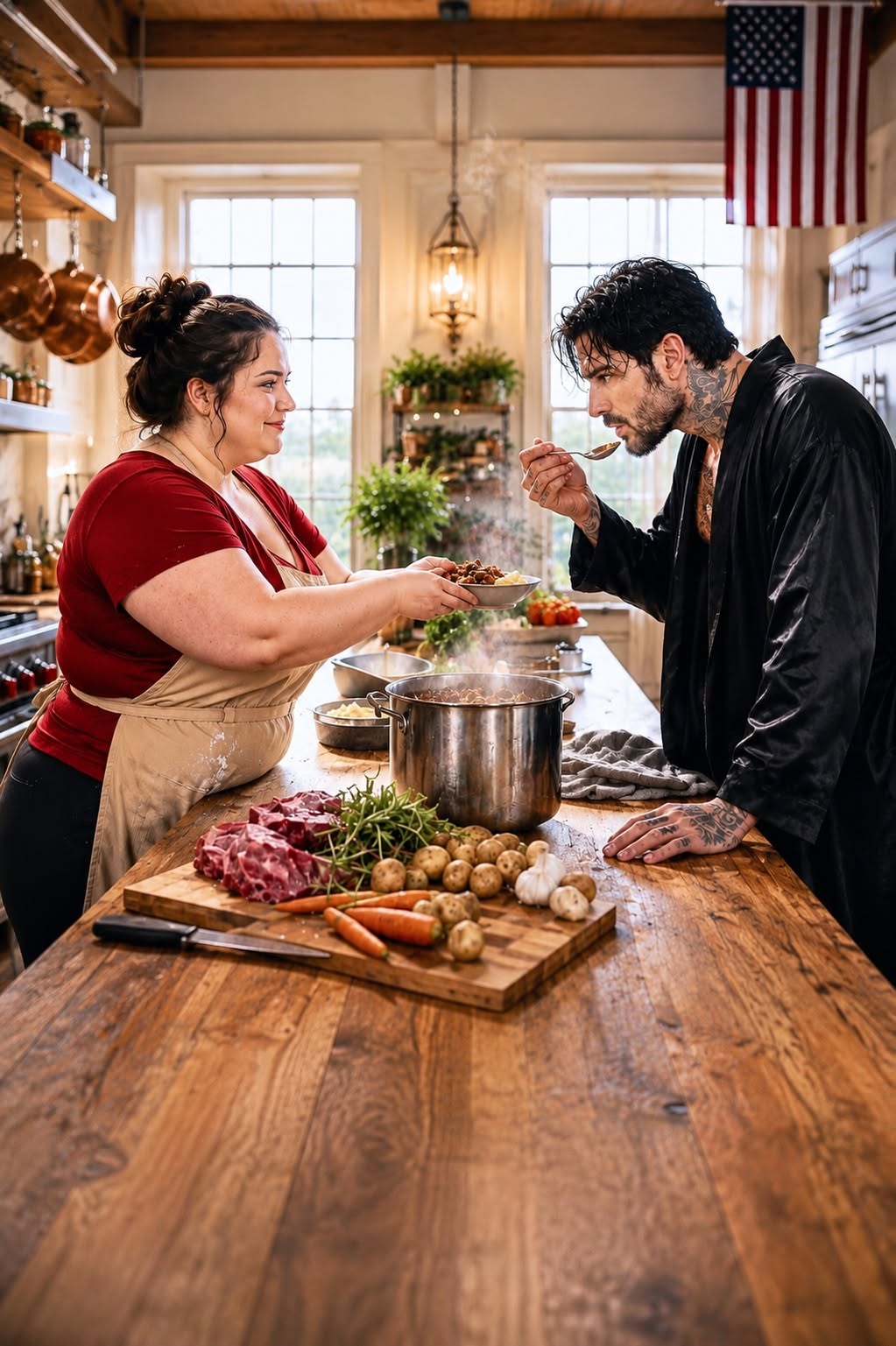
At closing, after the last customer left and the staff began wiping tables, Nora brought him a bowl of beef stew and garlic mashed potatoes.
The first meal.
He looked at it for a long moment.
Then at her.
“Still not fancy,” she said.
He smiled.
“Still just food?”
She sat across from him.
“Just food.”
Vincent picked up the spoon.
No fear.
No hesitation.
He ate.
Nora watched him take the first bite and remembered the storm, the mansion, the man in socked feet standing in the kitchen doorway like hunger had dragged him there against his will.
He had looked broken then.
Now he looked full.
Not only with food.
With life.
When he finished, he set the spoon down and reached for her hand.
“Same time tomorrow?” he asked.
Nora smiled.
“Same time tomorrow.”
May you like



And in a city built on noise, ambition, betrayal, and survival, a kitchen stayed warm long after midnight because one woman had believed the decent thing was always worth doing.
THE END







