Chapter 1
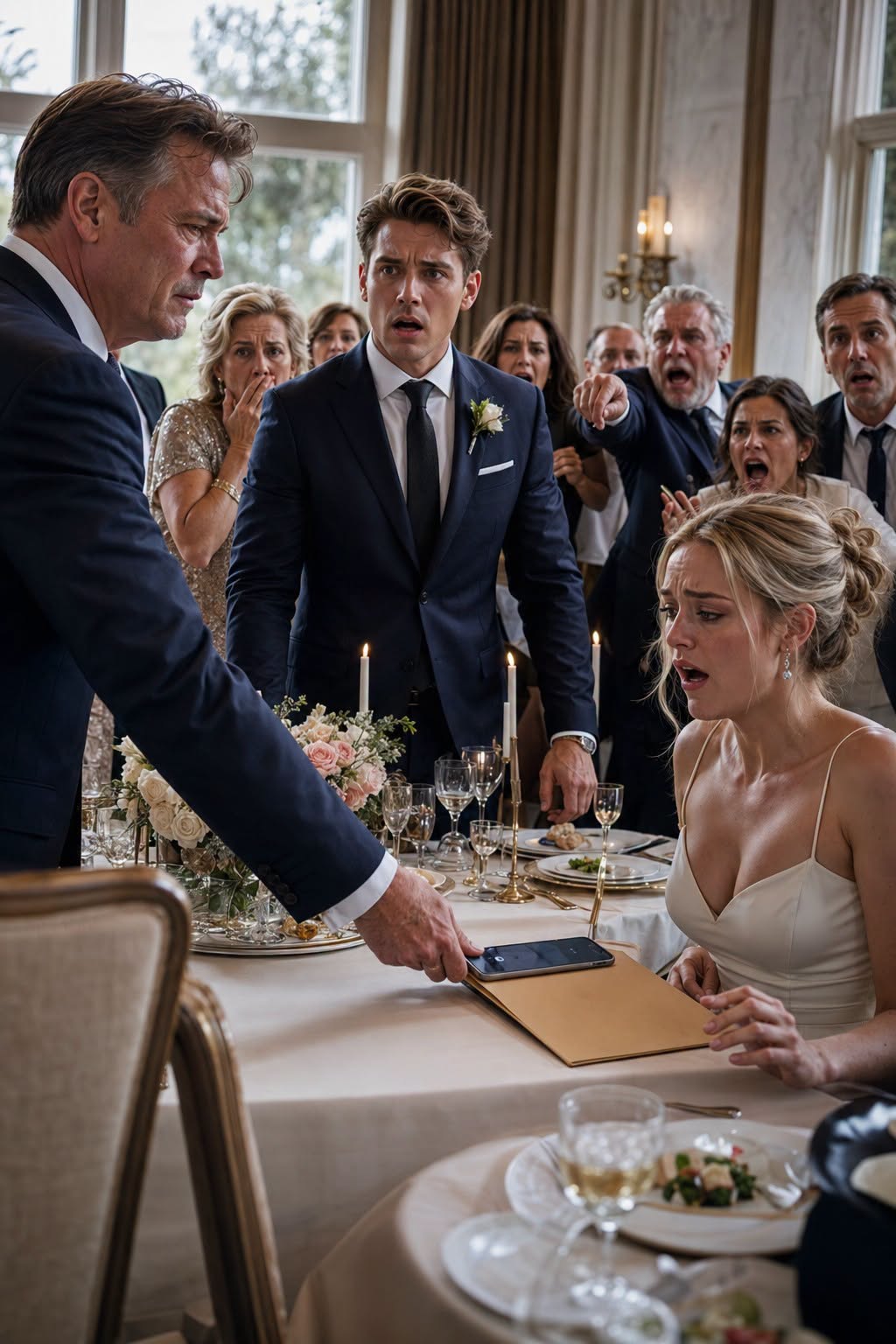
At My Son’s Engagement Dinner, His Fiancée Pulled Me Aside And Said, “Give Me $200,000, Or I’ll Tell Everyone You Attacked Me.” I Calmly Walked To The Table And Placed Two Things In Front Of Her That Made Her Go Completely Silent. The Dinner Ended In 11 Minutes.
### Part 1
The dinner ended in eleven minutes.
I know because I checked my watch twice that night. Once when Marissa leaned close to me on the back patio and said, “Transfer two hundred thousand dollars by Monday morning, or I’ll tell Daniel you put your hands on me.”
The second time was when I stood at the head of my own dining room table, with eighteen half-finished dessert plates in front of me, and said, “Everyone, I’m sorry, but the evening is over.”
At sixty-three, you learn there are moments when the room can smell danger before anyone understands why. The candles were still burning low between the serving dishes. The lemon tart my sister had brought sat untouched near the end of the table. A fork slipped against china somewhere on my left. My son Daniel looked up at me from beside his fiancée, confused, embarrassed, and still smiling because he thought this was just one of my awkward old-man moods.
Marissa did not smile.
She sat very still in Sandra’s old dining chair, one hand resting lightly on Daniel’s sleeve, her dark red nails curved against the fabric like little warning lights. Her face was calm, almost soft. To anyone else, she looked like a graceful woman trying not to be offended.
To me, she looked like a person waiting to see whether fear had worked.
My name is Walter Briggs. I live in a two-story craftsman house in Tacoma, Washington, three blocks from the water and half a mile from the first duplex I ever bought. I have spent thirty-four years building a property management company that started with one leaking roof, a borrowed ladder, and a used Chevy pickup that stalled at every red light.
People hear “property management” and imagine money stacked behind glass doors. The truth is more boring. It is burst pipes at two in the morning. It is tenants crying in your office because their husbands left. It is contractors who charge double if they think you don’t know the difference between copper and PEX. It is years of saying no to things you want so you can say yes to payroll, property tax, insurance, and another old building nobody else believes can be saved.
I’m comfortable now. That’s the word I use. Comfortable. I own my house outright. I drive a 2020 Ford F-150 with a dent near the back wheel. I buy socks in bulk. I still compare orange juice prices at Costco like the difference matters.
My wife, Helen, used to laugh at that.
Helen died seven years before the engagement dinner. Pancreatic cancer. Ninety-four days from diagnosis to the funeral. There are losses that knock you down, and there are losses that quietly move into your house and sit across from you every morning. Helen was the second kind. Her coffee mug still had a place in my cupboard, even though Daniel kept telling me I didn’t have to keep it if it hurt too much.
He never understood that some pain becomes part of the furniture.
Daniel was thirty-four when he met Marissa Vail. He had Helen’s patience and my stubbornness, which made him decent in ways I never had to teach him. He worked in commercial lending in Seattle, wore shirts that actually fit, and called me every Sunday evening even when he had nothing to say.
The first time he mentioned her, I was standing in my garage trying to fix a loose handle on an old toolbox.
“Dad,” he said, “I met someone.”
I heard it immediately. Not the words. The lift underneath them. Hope has a sound when it comes back into a person’s voice after being gone for years.
“Tell me about her,” I said.
“Her name’s Marissa. She’s from Los Angeles originally. She does brand strategy. Lifestyle stuff. Social media, private clients, boutique partnerships. I know that sounds vague.”
“It does,” I said.
He laughed. “You’ll like her.”
I wanted to.
A month later, he brought her to dinner at a restaurant in Seattle where the lighting was low, the portions were small, and the waiter described carrots like they had attended college. Marissa stood when I arrived. That was the first thing I noticed. Not many people do that anymore.
She had smooth black hair tucked behind one ear, a cream-colored coat, and the kind of smile that made you feel selected. She shook my hand with both of hers.
“Mr. Briggs,” she said, “Daniel has told me so much about you.”
“Walter is fine.”
“Then I’m Marissa.”
She complimented my watch before we sat down. A Seiko Helen bought me in 1996 after my first profitable year.
“I love when people keep things that last,” Marissa said. “It says so much about character.”
That was when the first small bell rang in my head.
Not an alarm. Not yet. Just a little sound from somewhere deep. She had chosen exactly the right sentence to say to a widower wearing an old watch.
May you like



I looked at Daniel. He was looking at her like the sun had learned his name.
So I ignored the bell.







