Chapter 5
PART 5
Julian Romano did not need to shout.
Men who shouted were often trying to borrow authority from volume. Julian’s authority came from the fact that everyone in the ballroom knew he could ruin lives while speaking softly enough for only the front row to hear.
He turned slightly, including the room in his words.
“Five years ago,” he said, “a woman found something of mine in Chicago. A briefcase containing contracts, accounts, and private records. In the wrong hands, those documents would have cost me more than money.”
No one moved.
Emma looked down.
She knew what he was doing, and she wished he would not.
Julian continued anyway.
“She was poor. Alone. Cold. She had every reason to sell what she found. Many people would have paid her enough to disappear forever.”
Victoria’s eyes flickered.
“She did not sell it,” Julian said. “She called the number inside and waited in the snow until I arrived. When I asked why she returned it, she said, ‘Because it wasn’t mine.’”
The ballroom had become perfectly silent.
“That woman was Emma Hart.”
A murmur rose, then died.
Julian looked at Victoria.
“In five years, I have trusted her with rooms my guards cannot enter, ledgers my lawyers cannot copy, and secrets powerful men would burn cities to possess. She has never betrayed one word. Never misplaced one dollar. Never touched one thing that was not hers.”
Victoria swallowed.
Julian’s voice hardened.
“And tonight you called her a thief because you could not tolerate a woman in an apron standing straighter than you.”
Senator Whitmore whispered, “Victoria, apologize.”
She shot him a furious look, but fear had entered her now. Real fear.
Julian lifted one hand.
“Open the safe.”
Emma raised her eyes. “Mr. Romano—”
“Please.”
That word surprised more people than the command.
Emma nodded.
Raymond selected witnesses: Senator Whitmore, two guests from opposite sides of the room, a retired judge, and Mrs. Eleanor Graves, an elderly philanthropist whose reputation for honesty made her impossible to dismiss.
Victoria followed because refusing now would look like guilt.
The group moved through the long hallway behind Julian’s study. The party remained behind them, buzzing in tense whispers.
At the locked room, Emma took the key from the chain beneath her uniform.
Victoria’s eyes fixed on it.
The key had rested against the maid’s heart all night.
Emma unlocked the door.
Inside, the private room was cool, windowless, and bright. A camera watched from one corner. The ledger lay on the table where Emma had left it.
She opened it to the proper page.
“Entry 17,” she said. “Diamond necklace. Silver setting. Pear-shaped center stone. Received from Victoria Whitmore at 9:42 p.m.”
The retired judge leaned in. “Clear record.”
Emma stepped to the wall safe and entered the code.
The steel door opened.
Compartment 17 held a velvet tray.
On it lay Victoria’s necklace, glittering under the white light.
Untouched.
Unstolen.
Undeniable.
For several seconds, no one spoke.
Victoria stared at the necklace as if it had betrayed her.
Senator Whitmore closed his eyes.
Mrs. Graves looked at Emma with something like sorrow.
“The necklace never left the safe,” Raymond said.
Emma removed nothing. She simply stood aside so everyone could see.
The retired judge turned to Victoria. “Mrs. Whitmore, your accusation appears to have been false.”
Victoria’s lips parted. No words came.
Because there was no lie left that could save her.
They returned to the ballroom with the truth walking ahead of them.
Whispers spread instantly.
The necklace was there.
The maid was innocent.
Victoria refused proof.
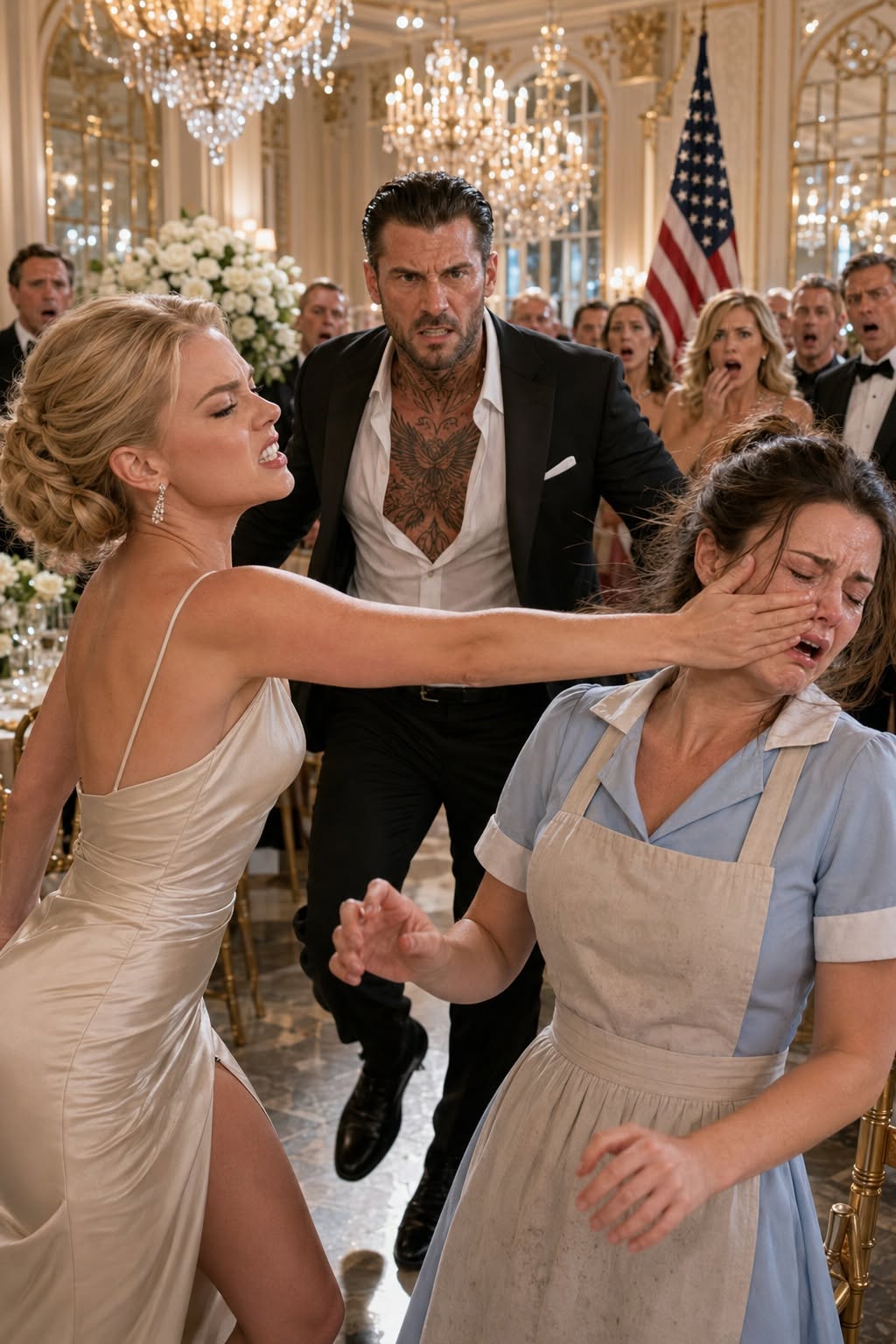
Victoria slapped her anyway.
Julian stepped into the center of the room.
“The matter of the necklace is resolved,” he said. “The matter of Mrs. Whitmore’s conduct is not.”
Victoria tried one last time.
“I was emotional,” she said. “Anyone would be upset over a family heirloom.”
Julian looked at her as if she had offered him something spoiled.
“You were offered proof before you struck her.”
Victoria’s face burned.
“It was a misunderstanding.”
“No,” Emma said softly.
Everyone turned.
Emma had not spoken since the safe room.
She stood beside Julian, hands folded, cheek still red.
“It was not a misunderstanding,” she said. “A misunderstanding wants truth. You refused truth.”
Victoria’s mouth trembled with anger.
Emma continued, calm but unyielding. “You wanted a thief. So you made one.”
The words hit the room harder than any accusation shouted in rage.
Then, from a table near the front, Mrs. Eleanor Graves slowly rose.
She was seventy-two, white-haired, elegant, and known across California society as a woman who remembered everything and forgave very little.
“I need to say something,” she announced.
Julian turned toward her.
Victoria went still.
Mrs. Graves gripped her cane. “Years ago, in Beverly Hills, I attended a private dinner at the Whitmore residence. A diamond ring was said to be missing. I remember the scene because it troubled me for years.”
Victoria’s face changed.
Not much.
Enough.
Mrs. Graves looked around the room. “A young maid was accused. Poor girl. Brown hair. Gray eyes. She said she had not taken it. She asked to be searched. She asked them to check her belongings.”
Emma’s breath caught quietly.
Mrs. Graves turned toward her.
“And she was not heard.”
Victoria whispered, “Eleanor—”
“No,” Mrs. Graves said. “I was silent then. I will not be silent again.”
The room sharpened around her.
“That young maid was thrown out that night without wages. No proof. No investigation. Only Mrs. Whitmore’s certainty that poverty was the same thing as guilt.”
Senator Whitmore stared at his wife.
Mrs. Graves’s eyes remained on Emma.
“I did not recognize you at first,” she said, her voice softer now. “But when she spoke tonight, when she used the same words, I remembered. It was you, wasn’t it?”
Emma stood very still.
Then she nodded once.
“Yes.”
The ballroom erupted in whispers.
Victoria stepped backward as if physically struck.
The cruelty was no longer an isolated incident. It was a pattern. A history. A mirror held up before every person who had ever smiled at Victoria and pretended not to notice the bodies her pride left behind.
Julian’s face became colder than anyone had seen it all night.
“You did this to her before?”
Victoria looked trapped. “I didn’t know it was her.”
Emma’s answer came quietly.
“That is the point.”
The room fell silent again.
Emma looked at Victoria, not with hate, but with something far worse for a woman like her.
May you like



Pity without weakness.
“You never knew it was me,” Emma said, “because you never thought women like me were worth remembering.”







