Chapter 2
PART 2
Three weeks earlier, Emily Parker had arrived at the Whitaker estate with two pairs of black shoes, a secondhand suitcase, and one rule she had made for herself after burying her younger sister.
Never ignore what feels wrong.
The mansion sat above the Pacific like something carved from money and grief. White stone walls. Floor-to-ceiling glass. Terraces overlooking the ocean. Security gates that opened without a sound. Everything was elegant, controlled, expensive.
But Emily felt the wrongness before she stepped through the front door.
It was too quiet.
Not peaceful quiet. Not the quiet of wealth. It was the held-breath quiet of a house waiting for bad news.
A woman in her sixties opened the door before Emily could knock. Her silver hair was pulled into a severe bun, and her black dress looked more like a uniform than clothing.
“You’re the replacement,” she said.
“Emily Parker,” Emily replied, forcing a polite smile.
“I’m Mrs. Alden, estate manager. You’ll report to me. Follow instructions exactly, and you’ll do fine.”
Emily followed her across marble floors that reflected the chandelier light like ice. She tried not to stare. She had cleaned houses in San Diego before—beach rentals, old ranch homes, downtown apartments—but nothing like this.
Mrs. Alden handed her a folder.
“Main duties are light housekeeping. The third floor is private. You’ll assist only when asked. Do not enter Mr. Whitaker’s office. Do not touch medical equipment. Do not question Dr. Vivian Cross.”
Emily’s fingers tightened around the folder. “Dr. Cross?”
“Caleb’s private medical consultant. She oversees his nutrition, supplements, sleep environment, and daily care plan.”
“Is she a physician?”
Mrs. Alden stopped walking.
Her gaze turned sharp.
“She is the only professional who has stayed with this family from the beginning. Mr. Whitaker trusts her completely.”
That was not an answer.
Emily said nothing.
Five years ago, she would have accepted the warning. She would have kept her head down, done the job, collected the paycheck, stayed invisible. That was what people like her were taught to do around people with power.
But five years ago, her sister Anna had died because Emily stayed quiet.
Anna had been twenty-one, bright, stubborn, funny, and impossible not to love. She had complained of stomach pain for weeks. Doctors called it anxiety. One even suggested she was seeking attention. Emily knew something was wrong. She knew it in her bones.
But she did not push hard enough.
By the time someone finally listened, the infection had spread through Anna’s body. Sepsis took her in thirty-six hours.
At the funeral, standing in the rain beside a closed casket, Emily made a promise.
Never again.
If her gut screamed, she would speak.
Even if no one wanted to hear her.
Mrs. Alden led her to the third floor. The air changed there. The walls were painted soft blue. Framed prints of superheroes hung beside the hallway lights. A child’s world had been carefully built above a billionaire’s mansion.
But it felt lifeless.
“This is Caleb’s room,” Mrs. Alden said. “He’s eight. He’s very ill. Do not excite him. Do not discuss his condition. Do not offer food, drinks, or opinions. Dr. Cross controls all of that.”
“Understood.”
Mrs. Alden hesitated, her strict expression softening for half a second.
“He was a sweet boy before all this,” she murmured.
Then she left.
Emily stood alone outside Caleb’s door.
A sticker of Captain America had been placed crookedly near the handle. Its edges were peeling.
Emily knocked softly.
No answer.
She opened the door.
The smell hit first: antiseptic, lavender, stale air, and something bitter underneath.
Caleb Whitaker lay in a large white bed surrounded by pillows. Too many pillows. His arms were thin beneath the blanket. His brown hair stuck to his forehead. Monitors blinked near the wall.
But his eyes were open.
“Are you the new lady?” he whispered.
Emily set down her cleaning caddy.
“I’m Emily. I’m here to help keep things tidy.”
“The last one left.”
Emily stepped closer, careful and slow. “I’m sorry.”
“People leave when they get tired of sick kids.”
The words landed in Emily’s chest.
She crouched beside the bed so he would not have to look up at her.
“I don’t scare that easy.”
Caleb studied her. “You look scared.”
Emily smiled faintly. “Maybe a little. Big houses make me nervous.”
That made him smile, barely.
It was the first sign of life in the room.
Over the next few days, Emily learned the rhythms of the third floor.
Dr. Vivian Cross arrived at eight, ten, two, and seven with smoothies, supplements, and clipped instructions. She was tall, blonde, flawless, and cold in a way that hid beneath perfect manners.
“Caleb requires consistency,” Vivian told Emily on the second morning. “Emotionally fragile children often attach themselves to staff. Don’t encourage it.”
“I’m only cleaning,” Emily said.
“Good. Then we understand each other.”
But Emily saw what others missed because no one expected a housekeeper to notice.
Caleb got worse after the smoothies.
Every time.
If he drank the purple one at ten, he vomited by noon. If he finished the green one at two, tremors started before dinner. If he refused or fell asleep before finishing, his color improved. His eyes brightened. He asked questions. Once, on a day he skipped half a drink, he sat up and laughed at a cartoon.
Emily began keeping notes.
Not written at first. Just mental timestamps.
Drink at 10:04. Vomiting at 11:47.
Drink at 2:10. Tremors at 4:03.
No morning drink. Stronger all afternoon.
A pattern formed.
A terrible one.
Then she found Caleb’s notebook.
It was wedged behind a stack of picture books. Blue cover, worn corners, a faded superhero sticker on the front. Emily should have put it back. She knew that.
But something told her to open it.
The first page was dated almost a year earlier.
The purple drink made my stomach burn again. Dr. Cross says medicine hurts before it helps. I wish helping didn’t feel like dying.
Emily sat down on the floor.
Page after page, Caleb had written what the adults ignored.
Dad cried in my room last night. I pretended to sleep so he wouldn’t be more sad.
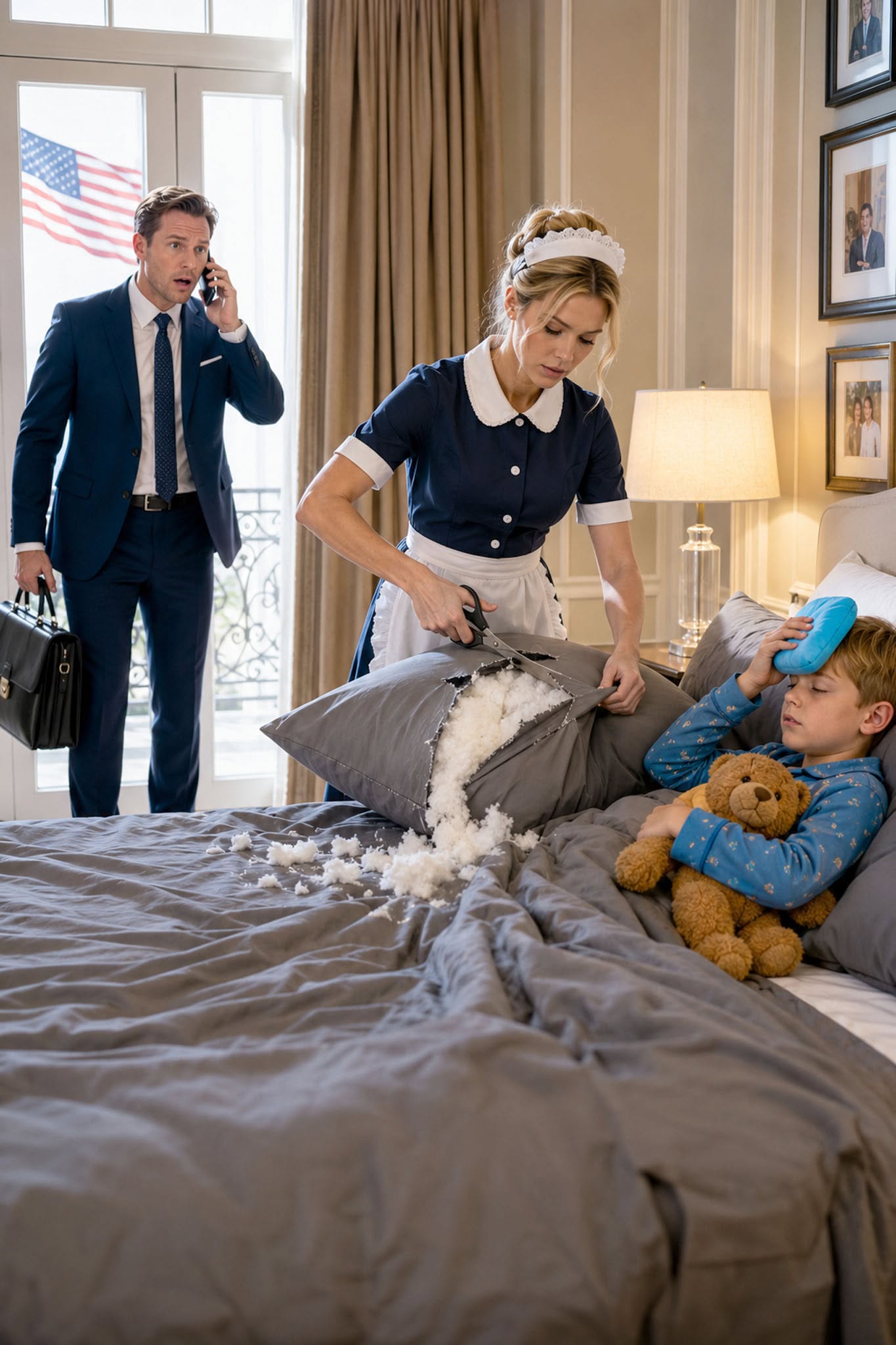
Dr. Cross said I need the pillows because my lungs are weak. They smell funny.
I didn’t drink all my smoothie today and I felt better. Maybe I’m bad for thinking that.
Emily closed the notebook with shaking hands.
That afternoon, she saw Dr. Cross washing her personal blender cup in the medical suite sink. Vivian always washed it herself. Always. But an emergency phone call pulled her away before she finished.
Emily waited.
Then she entered.
The cup sat wet in the sink. She leaned close.
The smell was bitter, metallic, and floral.
Wrong.
She swabbed the residue, sealed it in a tiny plastic bag, and called her cousin Nathan, a toxicology resident at UC San Diego.
“I need you to test something,” she said.
“Emily, what did you get yourself into?”
“A child might be in danger.”
There was a pause.
“Bring it tonight.”
Three days later, Nathan called her at 1:13 a.m.
His voice was shaking.
“Emily, that sample contains oleander compounds. It’s poison. Chronic exposure could mimic a progressive illness. Heart irregularities, vomiting, weakness, tremors, seizures.”
Emily sat on the edge of her narrow staff-room bed, unable to speak.
Nathan continued, “Where did you get this?”
She looked up at the ceiling.
May you like



Above her, somewhere in that enormous mansion, Caleb was sleeping on pillows that smelled funny.
“From a little boy’s medicine,” she whispered.







